BOUNDLESS: Interview with SK Reed, artist and co-founder of The Waiting Room
by Christina Nafziger
In the series BOUNDLESS, we chat with artists across the US who run their own galleries,
recontextualizing these art spaces as key elements of an artist’s creative practice.
Can a gallery be a creative practice? Can an art piece be an exhibition, an art space? Imagine for a moment that art making has no boundaries. Instead, it is BOUNDLESS, free from constraint of form, medium, or even function.
This new series considers an artist-run space not just as a creative experiment, but also as an act of art-making that is part of the founder’s practice. These artists/founders are on the forefront—they see what is possible in their minds eye often before most of us can even imagine it. Then, with or without fear, they pursue it. They create the kind of spaces they want to exist, spaces that push the art world in a different direction, altering the course of local cultural ecosystems. Artist-run spaces have the capability of showing us in real time what other types of structures and systems are possible within the art world (and perhaps the world at large).
In each installment, I’ll be chatting with the artist behind the artist-run space, artists who have taken it upon themselves to start building the infrastructure needed for growing and nourishing a thriving art community.
In this installment, I spoke to SK Reed, co-founder of The Waiting Room in Kansas City, MO. What started as a small gallery in a flower shop back in 1999 has now evolved into a 5,000-square-foot art space that houses five artist studios and a gallery. SK Reed, who became involved with the gallery in 2022 during its run as ‘Beco Gallery,’ is no small part of the gallery’s evolution. Reed and their partner David Lieffring, both artists, renovated The Waiting Room’s current space, which will house 15 exhibitions this year alone.
With a unique, collaborative curatorial model, The Waiting Room offers a more sustainable method of making art WORK. In our conversation, Reed tells me about the importance of interdependence and collaboration in their personal art practice as well as in their curatorial work, citing tall grass prairie ecosystems as a source of inspiration. Join us as we Reed tells us how their multifaceted practice interlocks with their arts administration work as well as what lies ahead for The Waiting Room.
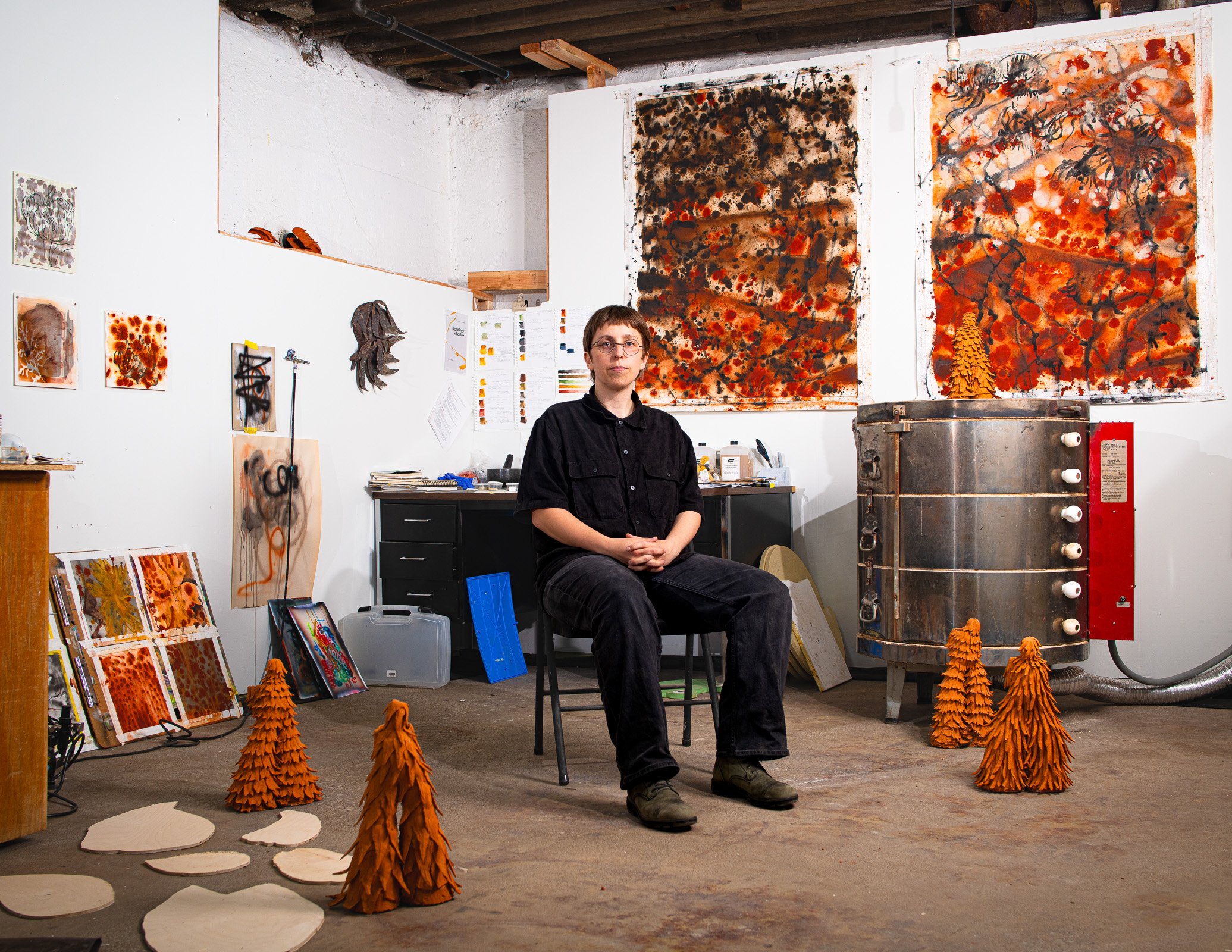
Image: A photo of SK Reed in their studio surrounded by their artwork. Photo by Yash Singh.
The story of The Waiting Room starts in 1999 as Beco Gallery and has since transitioned into its current form. When did your involvement begin, and what originally brought you to the space?
I began curating for Beco Gallery in 2022. At the time, it operated out of a flower shop, with a gallery in the front room. I was in graduate school at the University of Kansas when Elise Gagliardi reached out, looking for someone to take over curatorial responsibilities. I organized my first open call, but shortly after notifying selected artists, we learned the landlord was doubling the rent. The flower shop had to relocate to a smaller space that could no longer accommodate a gallery.
For two years after Beco Gallery closed, I continued hosting exhibitions across Kansas City in various off-site locations. Eventually, I found myself working out of a very temporary basement space with fluorescent lighting and a reception desk in the middle. It had an office-like, transient quality that inspired a new name: The Waiting Room. The name reflects both the physical atmosphere and the impermanence often inherent in artist-run spaces. Eventually we had to leave this location as well.
During MdW Summit in Kansas City, I heard about another available basement in the Holsum Building in the West Bottoms, an area with a strong concentration of artists and artist-run spaces. My partner, David Lieffring, and I decided to take it on. The roughly 5,000-square-foot basement was raw, dirty, with minimal lighting, and no real infrastructure. We power-washed, sealed, painted, built studios, and installed electrical and lighting from scratch.
Today, the space includes five artist studios and a gallery. We currently host nine studio artists, many sharing the large studios, and we have fifteen exhibitions planned across the main gallery and hallway, which functions as a secondary exhibition space.
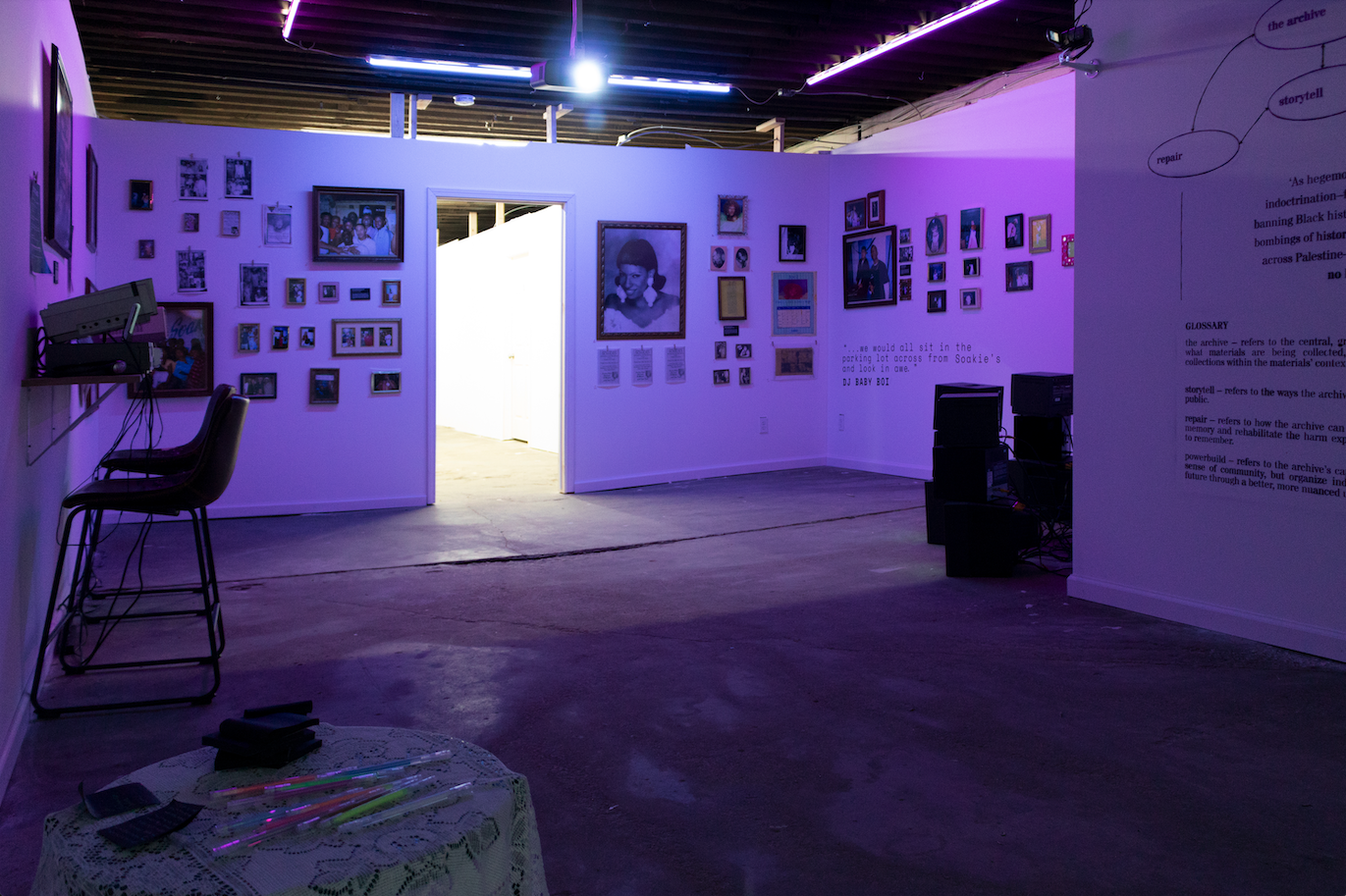
Image: Installation view of Nasir Anthony Montalvo: SOAKIE’S WAS HOME at The Waiting Room. Image courtesy of SK Reed.
Can you tell us about your role at The Waiting Room and your involvement in its evolution?
I’m the co-founder, alongside my partner David Lieffring. We built the space together with help from our families, and we also share a studio there. Before moving into this larger space, I was running the project independently as the sole curator, doing all the gallery work myself. As it expanded, it became clear that collaboration was necessary for sustainability.
Lily Erb joined as the first co-curator, followed by Abbie Stabno, our current gallery manager. We later brought on four additional co-curators, Mia Johnson, Yasi Farah, Xiao Faria da Cunha, and Rebecca Blocksome. Each of them plays an essential role in shaping the gallery.
My role has gradually shifted into more of a behind-the-scenes director position. I focus on long-term planning, managing the studios, overseeing operations, and supporting the curatorial team. I also continue to co-curate exhibitions. Sharing this work has been incredibly meaningful. It has allowed us to build a collaborative structure where we learn from one another while supporting each other’s practices. It’s an evolving ecosystem shaped by the people who move through it, much like the mutually supportive ecological relationships I explore in my artwork.
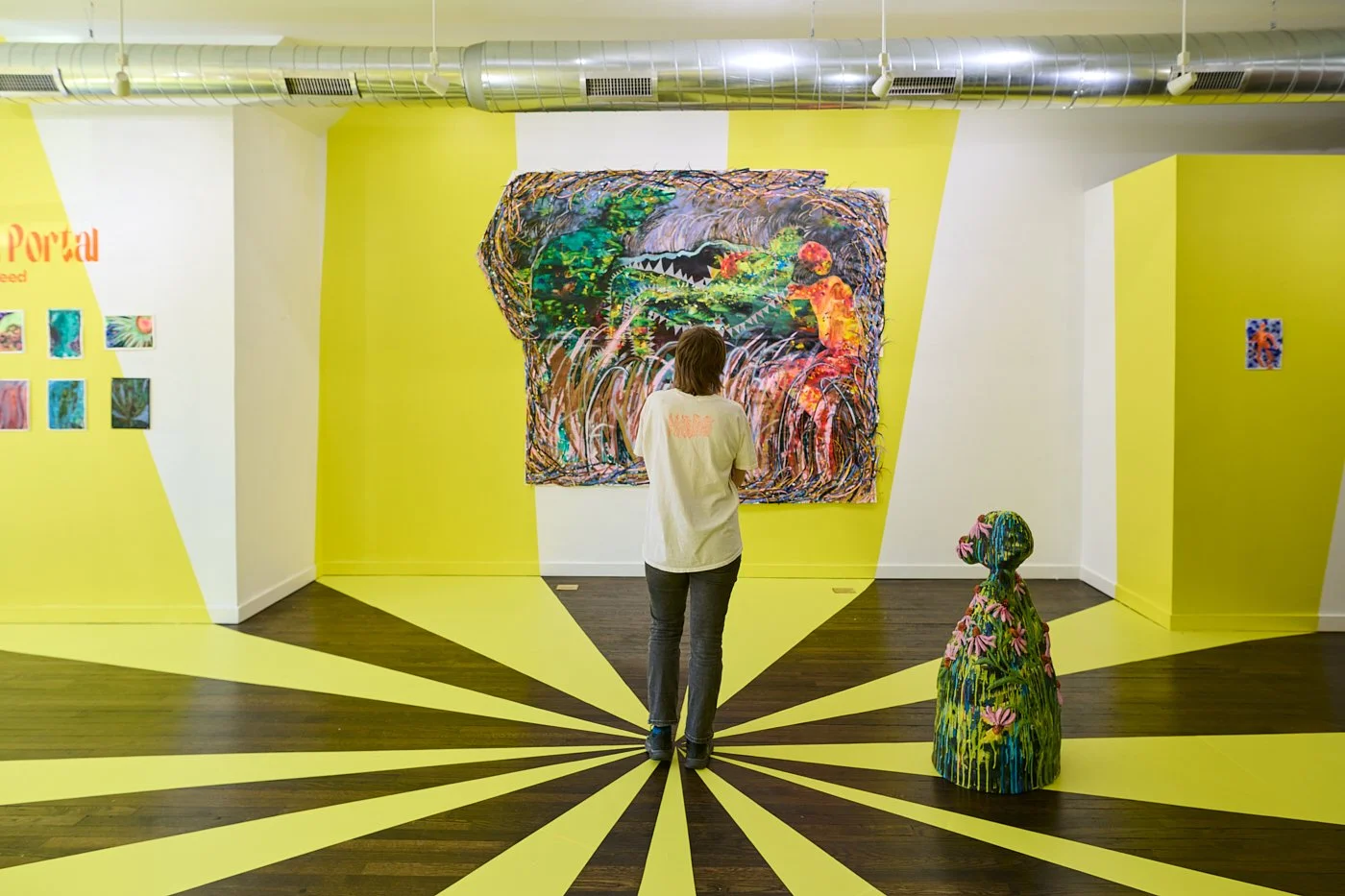
Image: An installation view of SK Reed’s solo show Present Portal at Smalter Gallery in Kansas City. Image courtesy of SK Reed.
I’d love to hear about your art practice, which is often sculptural and site-specific. What materials do you use, and what are you currently exploring?
My practice moves fluidly between painting, ceramics, installation, and occasionally printmaking, particularly Mokuhanga. Recently, I have been focusing on aligning my conceptual interest in place-based learning with my material choices. This has led me to harvest my own clay and experiment with local earth pigments.
Working with materials sourced from my region feels grounding. It deepens my relationship to place and requires a more intentional, physical engagement with the landscape. I think a lot about what it means to learn from more-than-human beings such as plants, insects, and ecosystems that operate outside of capitalist extraction. While I still use non-foraged materials, this process has become an important and generative part of my practice.
I move between painting and ceramic sculpture, drawn to their different approaches. Painting allows for a kind of immediacy and illusion, while sculpture offers a way to build real form in space. Lately, I have been creating small, abstract creatures from local clay, covered in pinched petals and textures inspired by tallgrass prairie species.
I am particularly interested in ideas of transformation, queerness, and the fluidity of the body, as well as how deeply interconnected we are with the species we share this world with. I think about what these relationships can teach us about living in more sustainable ways that allow for mutual flourishing. For example, the caterpillar of the wavy-lined emerald moth camouflages itself by covering their bodies with plant matter as a survival strategy. That kind of adaptive transformation resonates with me, changing your body to meet your needs. Drawing from Judith Butler’s idea that “fantasy is not the opposite of reality, but what reality forecloses,” I think about how queerness, alongside an expanded sense of ecological kinship, opens space for alternative ways of being in our often harrowing world.
My work imagines bodies not as fixed or isolated, but as porous and relational, constantly shaped by what they encounter. The prairie becomes a model for mutualism and shared flourishing, offering a counterpoint to more rigid and extractive ways of living.
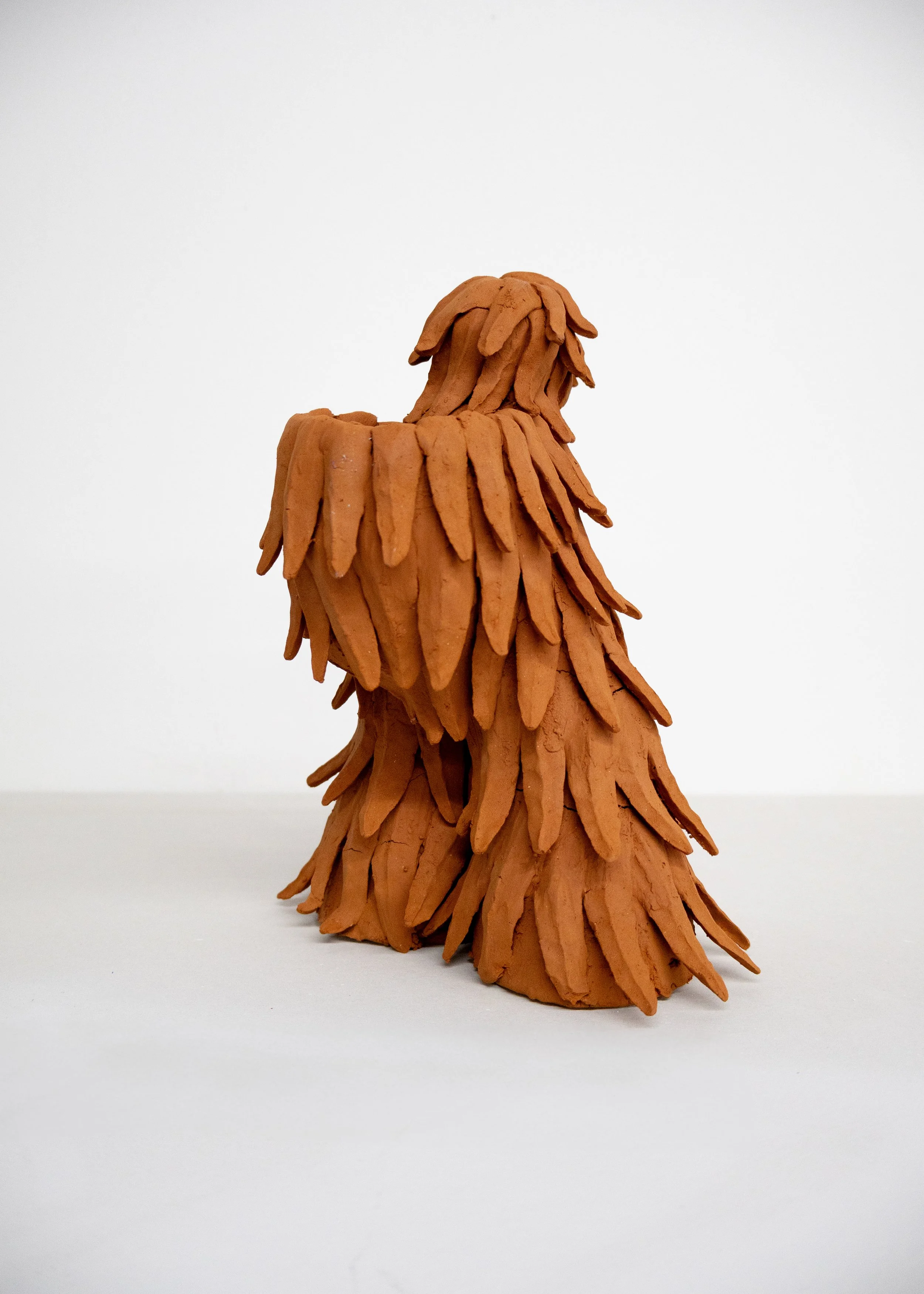
Image: A sculpture titled Creature I (Whole-leaf Rosinweed) by SK Reed. Image courtesy of the artist.
How does The Waiting Room intersect with your art practice? Do you see it as separate or as an extension of your work?
They are deeply connected. My art practice is rooted in ecological systems that emphasize collaboration, and The Waiting Room operates in a similar way on a social level. It is a space built on shared resources, knowledge, and care to create more opportunities for others.
In my studio, I am thinking about ecosystems grounded in reciprocity and interdependence. The Waiting Room reflects that thinking as a kind of social ecosystem where artists support one another and collectively create opportunities that might not exist otherwise. It is an attempt to move away from individualism and toward more sustainable, community-centered models.
Practically, they function differently. Running the gallery involves a great deal of administrative work, which contrasts with the openness and experimentation of my studio practice, but there’s some of that happening with the studio and gallery as well. Keeping boundaries between the two is helpful, making sure to keep time to develop my studio practice.
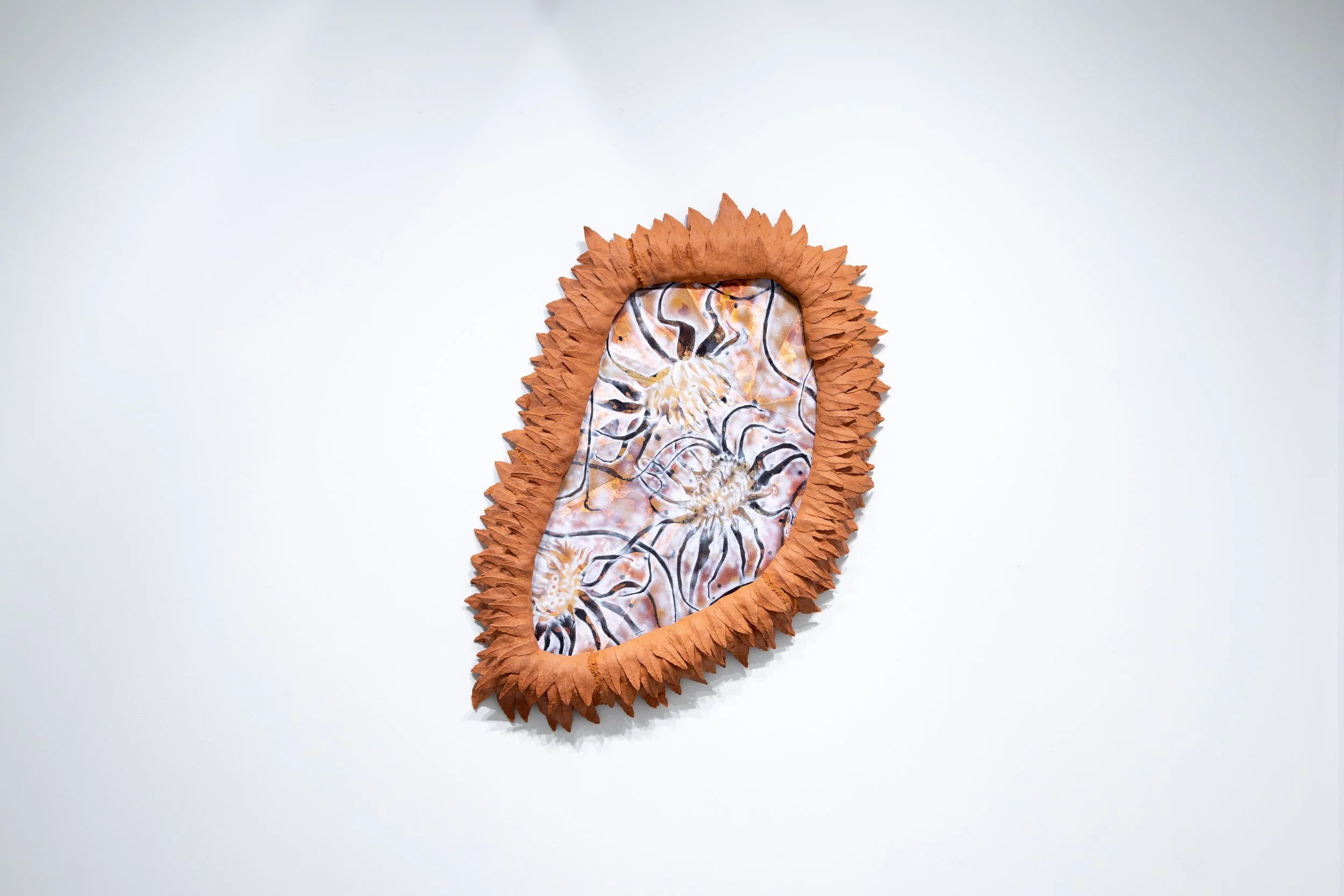
Image: A sculpture titled Sunflower Seed (light) by SK Reed. Image courtesy of the artist.
How has your work at The Waiting Room shaped your approach to art-making and your understanding of being an artist?
Right now, I feel energized by the ability to contribute to my community in a direct way. Earlier in my career, I struggled to find opportunities to show my work and often felt isolated. Curating became a way to create space for artists at similar stages, people taking risks, trying new ideas, and navigating their first exhibitions.
This work has introduced me to a wide network of artists, curators, and supporters. It has also challenged traditional ideas of what it means to be an artist. We are often taught to pursue representation or wait for major opportunities, but those pathways can feel transactional and inaccessible. I strongly believe in creating the spaces you need, starting small in whatever ways feel accessible. It is important to ask for what you need, but also to give something back, to co-create rather than simply take. These systems become sustainable when we support one another. That is how meaningful, lasting relationships are built.
I have been thinking a lot about adrienne maree brown’s idea that “what you pay attention to grows.” Curating has shifted my attention outward toward other artists, their ideas, and the ecosystems we are building together. Meeting and supporting so many artists and curators has helped me feel part of something larger. We are building mutual networks that often operate outside of dominant capitalist models and instead prioritize care.
Being an artist-curator is demanding, and time is always limited, but it is also deeply rewarding. The relationships I have built through this work feel reciprocal and sustaining. We are committed to supporting one another while pushing our practices forward.
Other avenues in the art world have not always felt accessible to me. There are real class barriers. Financial resources shape who can produce work, apply to opportunities, travel, and ship work. Building genuine relationships has been essential for me. I have stayed on friends’ couches while installing exhibitions in other cities, and people have shown up to help me install work or connect me to opportunities. In return, I offer the same support, whether through feedback, labor, or sharing resources. That exchange of care is what has made it possible for me to continue.
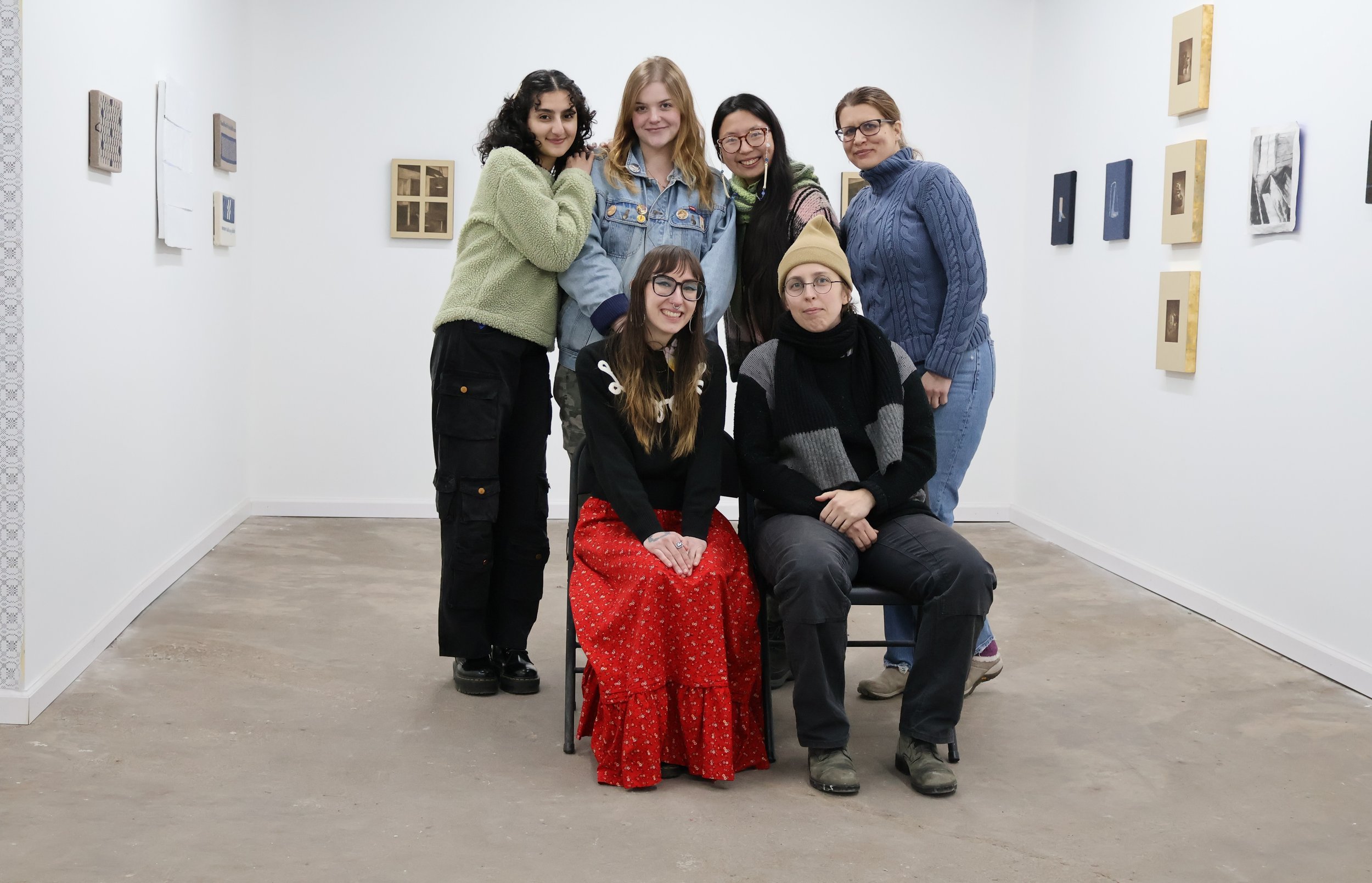
Image: A photo of six of the co-curators of The Waiting Room, inside Main Gallery exhibition Empty Hours featuring work by Esther Bach, Kate Harmon, and Evi Heinen. Image courtesy of SK Reed.
The Waiting Room has a unique curatorial model involving multiple curators. How does that structure operate?
We currently have a team of seven members and will soon transition to six. Each year, we host an open call from December through January. As a team, we review proposals and collectively select exhibitions for the upcoming year.
We program both the main gallery and the hallway space, with flexibility to incorporate projects that emerge organically throughout the year. We also reserve one exhibition slot for our studio artists.
Each co-curator leads at least one exhibition annually and contributes to a specific operational role, such as manager, social media, documentation, grant writing, or website maintenance. Since this is entirely unpaid, we prioritize a low-stakes atmosphere and support when you need it.
Sharing responsibilities has made the project sustainable. Previously, managing everything alone was not feasible. This collective structure allows the space to function more like an interdependent system rather than common hierarchical models.
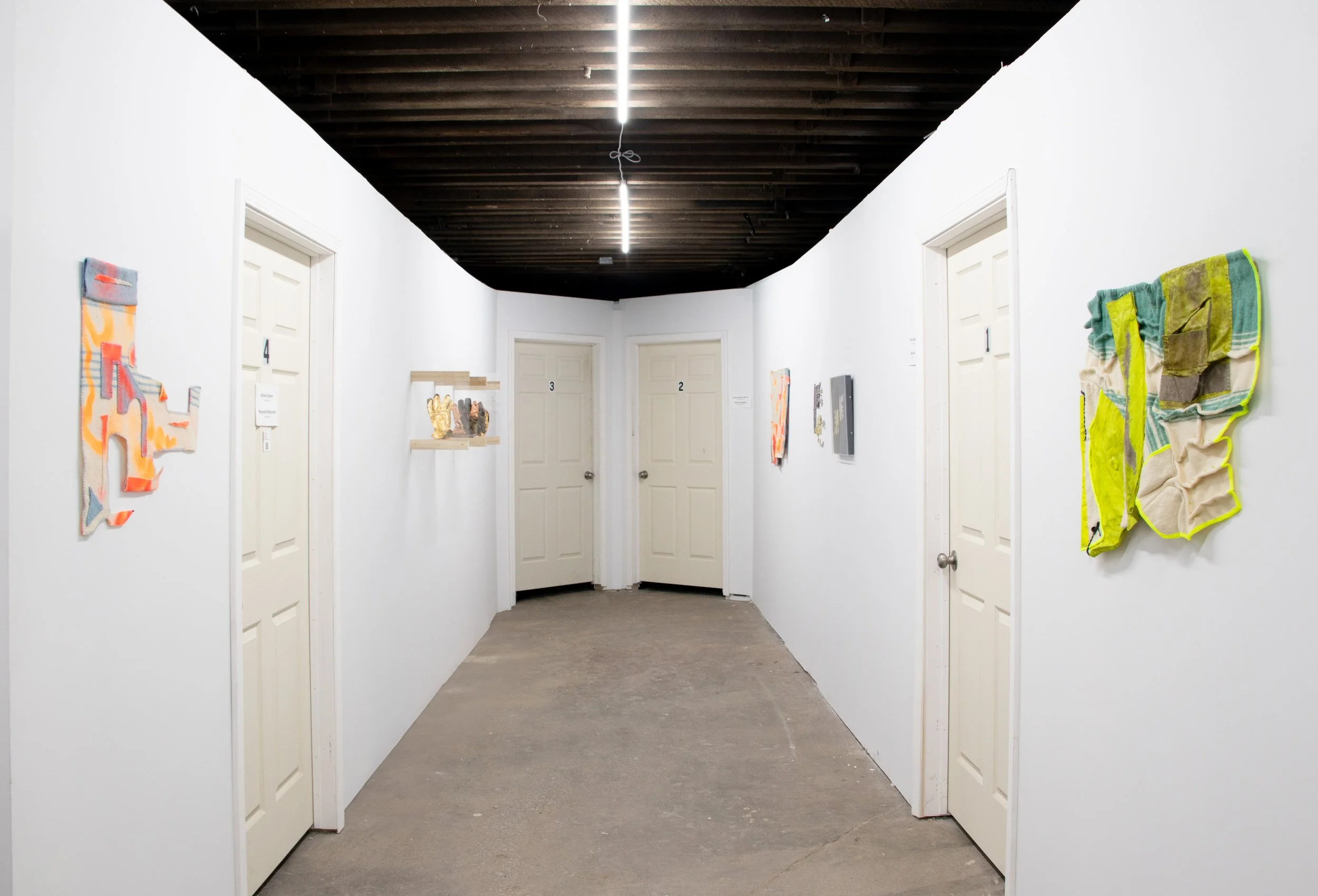
Image: A photo showing a hallway at The Waiting Room that leads to artist studios. Hallway exhibition, These Shining Hours with artwork from Catherine Reinhart. Image courtesy of Mia Johnson.
Do all of the curators maintain their own creative practices? How does that influence collaboration?
Yes, everyone on the team is an active artist. That shared experience deeply shapes how we collaborate. We all understand the challenges of balancing time, energy, and creative work, which fosters a sense of empathy and flexibility.
If someone has an exhibition, residency, or personal commitments, others step in to support. We rely on one another in ways that make the whole system more resilient.
We also make space, when possible, to engage with each other’s practices through informal presentations, conversations, or simply showing up in support. Having peers who are genuinely invested in your growth makes a significant difference. There is a strong sense of respect and encouragement within the group.
Are you originally from Kansas City? What makes this place meaningful to you?
I grew up about 40 minutes east of Kansas City. After undergrad at the University of Central Missouri, I was eager to leave the region and spent two years in New York. While it was an incredible experience, it ultimately was not sustainable for me financially or mentally.
Returning to Kansas City after experiencing such an incredible art city like NYC offered a different kind of possibility. Kansas City was more affordable, which allowed my partner and myself to buy a house. That would not have been possible in a larger city. It is also a growing arts community where it still feels possible to make an impact.
At the same time, the region has its complexities. I grew up in a very religious environment, which shaped my experience in complicated ways. Creating a space that centers diverse voices, especially for queer and emerging artists, feels both necessary and personally meaningful. In many ways, it is about building the kind of environment I wish I had encountered as a young person.
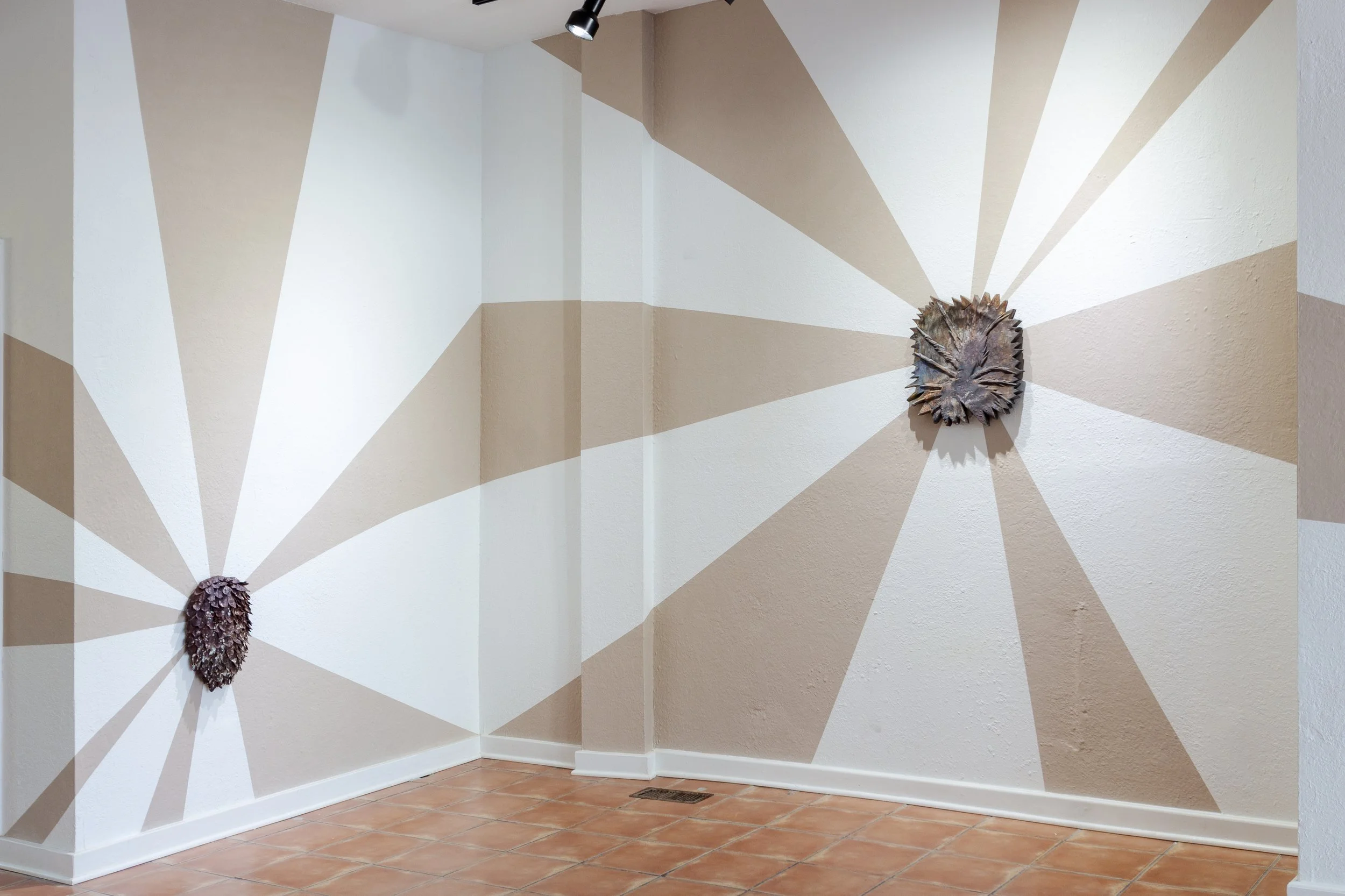
Image: An installation view of SK Reed’s solo show The Unreal at United Colors in Kansas City. Image courtesy of César López.
What’s next for you?
I am currently part of Queer Ecologies II, a collaboration between The Waiting Room and Purple Window, on view at Charlotte Street through May. The exhibition brings together twenty queer artists from the Midwest engaging with ecological counterparts. It’s the second iteration, all artists found through open calls!
I am also included in Kinetic Kin in Brooklyn, curated by Neptune in June/Jenn Cacciola, part of the inaugural Trans Art Festival founded by Carter Shocket. The exhibition features seventeen trans artists and runs through the end of May.
This August, I will have a solo exhibition at 3West, an artist-run gallery in our building. I am also participating in Home Grown II at the Ukrainian Institute of Modern Art in Chicago this July.
At The Waiting Room, we have two upcoming exhibitions opening this May, a solo by Ashleigh Robek and a group exhibition by our studio artists and co-curators. Followed by our annual residency program featuring Vaughn Sanchez and Katie Swan. Each will develop new work on-site, culminating in a two-week exhibition in mid-July.
We have an exciting year ahead and are always open to collaboration. You can follow along through our website or Instagram.
Co-curatorial Team:
Rebecca Blocksome @rebeccablocksome
Xiao daCunha @xiaochineseart
Lily Erb @lilywelderb
Yasi Farah @ayeitsyasi
Mia Johnson @hostileheifer
SK Reed @sk__paints
Abbie Stabno @cherryredocs
The Waiting Room Studio Artists:
Studio 1: Dora Agbas & Alison Krenzer @doraagbas @alisonkrenzer
Studio 2: Laine Imes, Hannah Luechtefeld, and Andrea Shonna Simon @hell.frasier @hannaluechtefeld @andreashonna
Studio 3: David Lieffring and SK Reed @dalieffring @sk__paints
Studio 4: Mike Hill @mikehill_kc
Studio 5: Alexage Savage @alexsavage_alexsavage