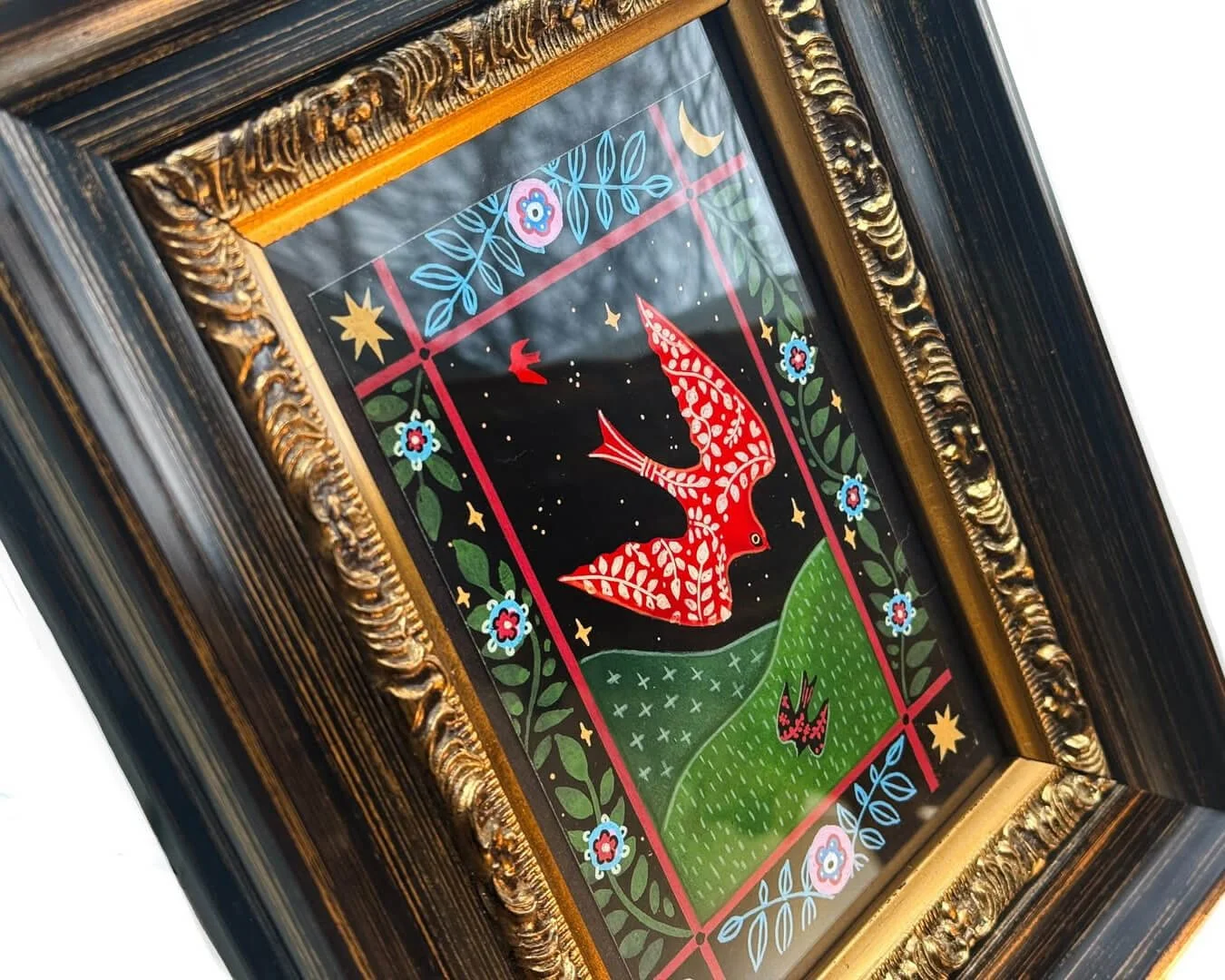
Art as Sanctuary: Aunia Kahn on Survival, Transformation, and Finding Joy
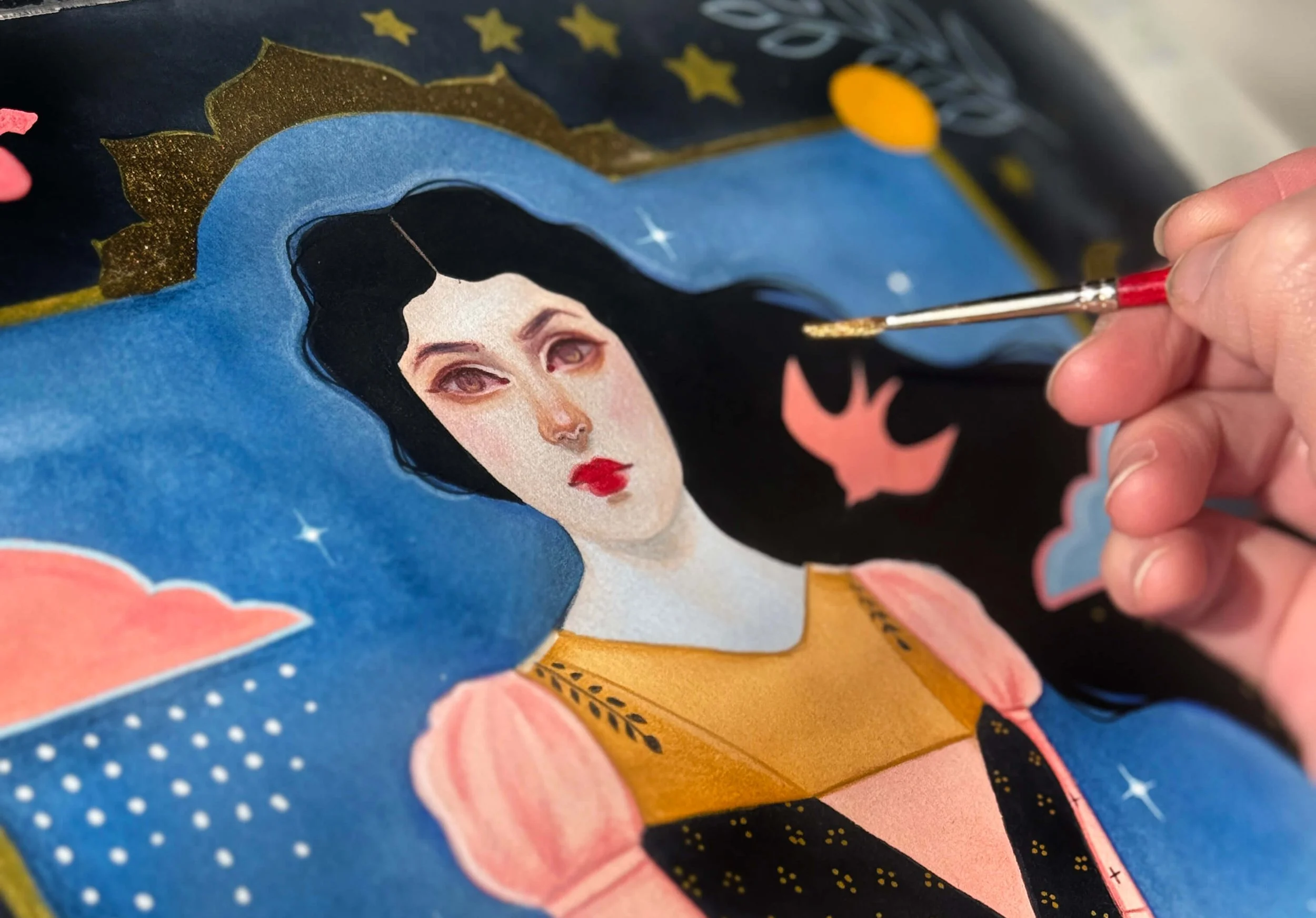
Born in Detroit, Michigan in 1977, Aunia Kahn is a multidisciplinary curator, gallerist, and visual artist working primarily in gouache, acrylic, oil pastel, and colored pencil. She creates vibrant compositions that blend personal narrative with diverse cultural influences. Her art began as survival—a therapeutic response to a difficult upbringing and ongoing health challenges that evolved into a dedicated studio practice and career. This foundational relationship between art-making and personal transformation continues to inform her work today. She draws inspiration from her French Canadian heritage, German and Polish folk art, iconography, Pre-Raphaelite and surreal artists, and the natural world. Her work features symbolic storytelling through layered imagery, rich color palettes, and architectural forms, balancing the mystical with the domestic to create narrative depth around themes of sanctuary and transformation. Her artwork has been exhibited in over 300 exhibitions across 10 countries, including San Diego Art Institute, Los Angeles Center for Digital Art, iMOCA, St. Louis Art Museum, Contemporary Art Museum St. Louis, Mitchell Museum, and the Jordan Schnitzer Museum of Art. She has curated numerous national and international exhibitions and book projects and has been featured in publications like Yahoo, Prevention Magazine, and Authority Magazine. She has also lectured at colleges and universities at places like Washington University School of Medicine, and at other institutions like Scott Air Force Base and New Jersey Visual Arts. She is also the founder and CEO of Rise Visible, a website design and digital marketing agency with over 26 years of experience, co-owner of Poetic Tiger Gallery, co-owner of Magpie Rookhouse, publisher of Hyperlux Magazine, and host of the Curated Muse Podcast.
Learn more: auniakahn.com
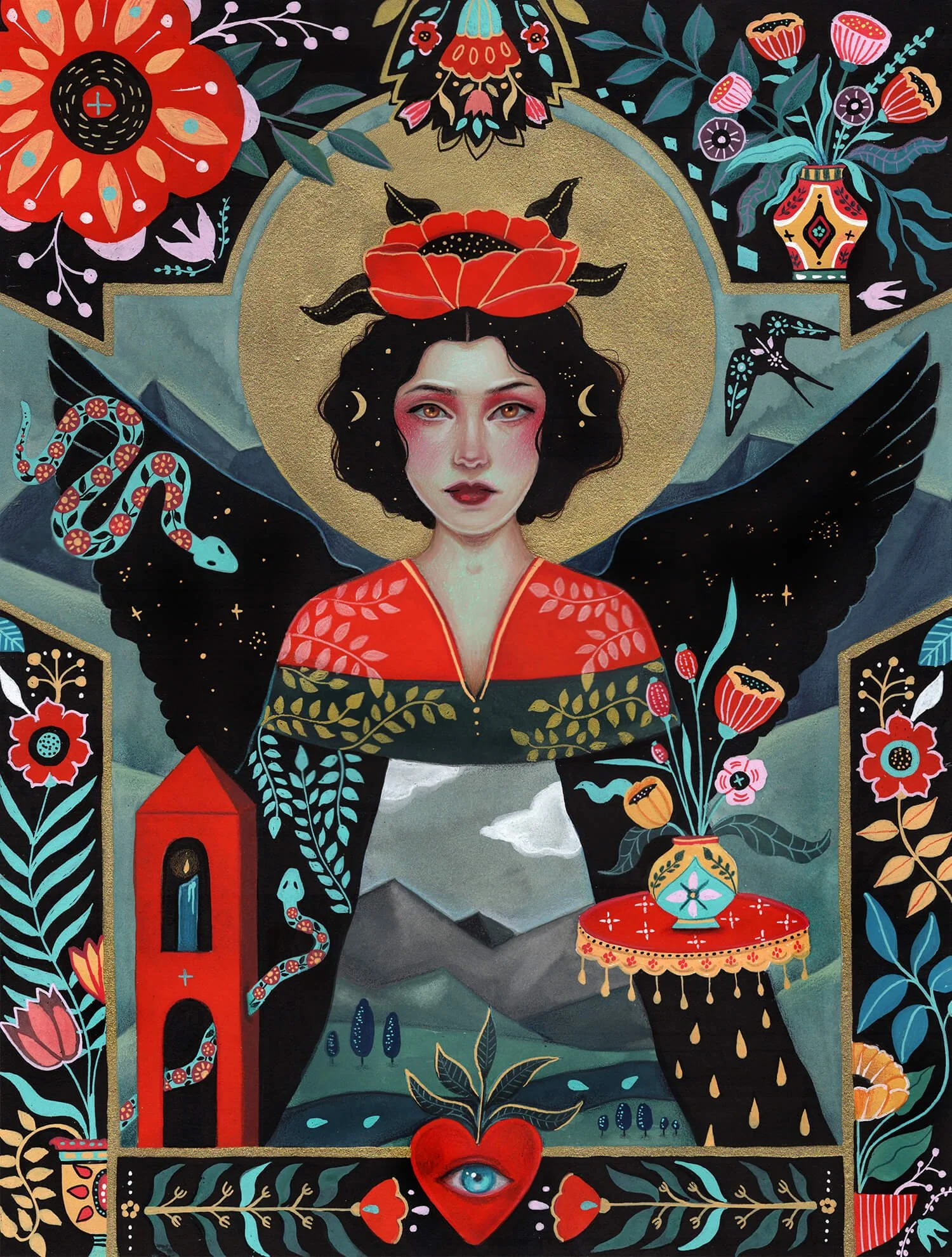
You have shared that art began as a way to survive and heal. How does that beginning still influence your work today?
Although I'm way more medically stable today than I was for most of my career, art will always be a place of survival for me because it is something I need to help manage what I deal with daily. However, unlike years ago when art was almost solely about survival, the very thread that kept me alive and on this planet, today it's paired with joy. And that feels really good.
Your work often includes symbolism, architecture, and storytelling. How do you decide what elements belong in a piece?
I let the work inform me. Unlike many creators who have a complete vision before they start, mine comes together organically and the painting reveals itself as I make it. It might sound strange, but the work actually tells me what it needs, what belongs. It feels pretty magical.
At times I've wished I was more of a visionary, where I have the whole piece in my head and just need to get it onto paper. But I find it exciting not knowing how it will end up and discovering the story and symbolism as the piece shows itself along the way.
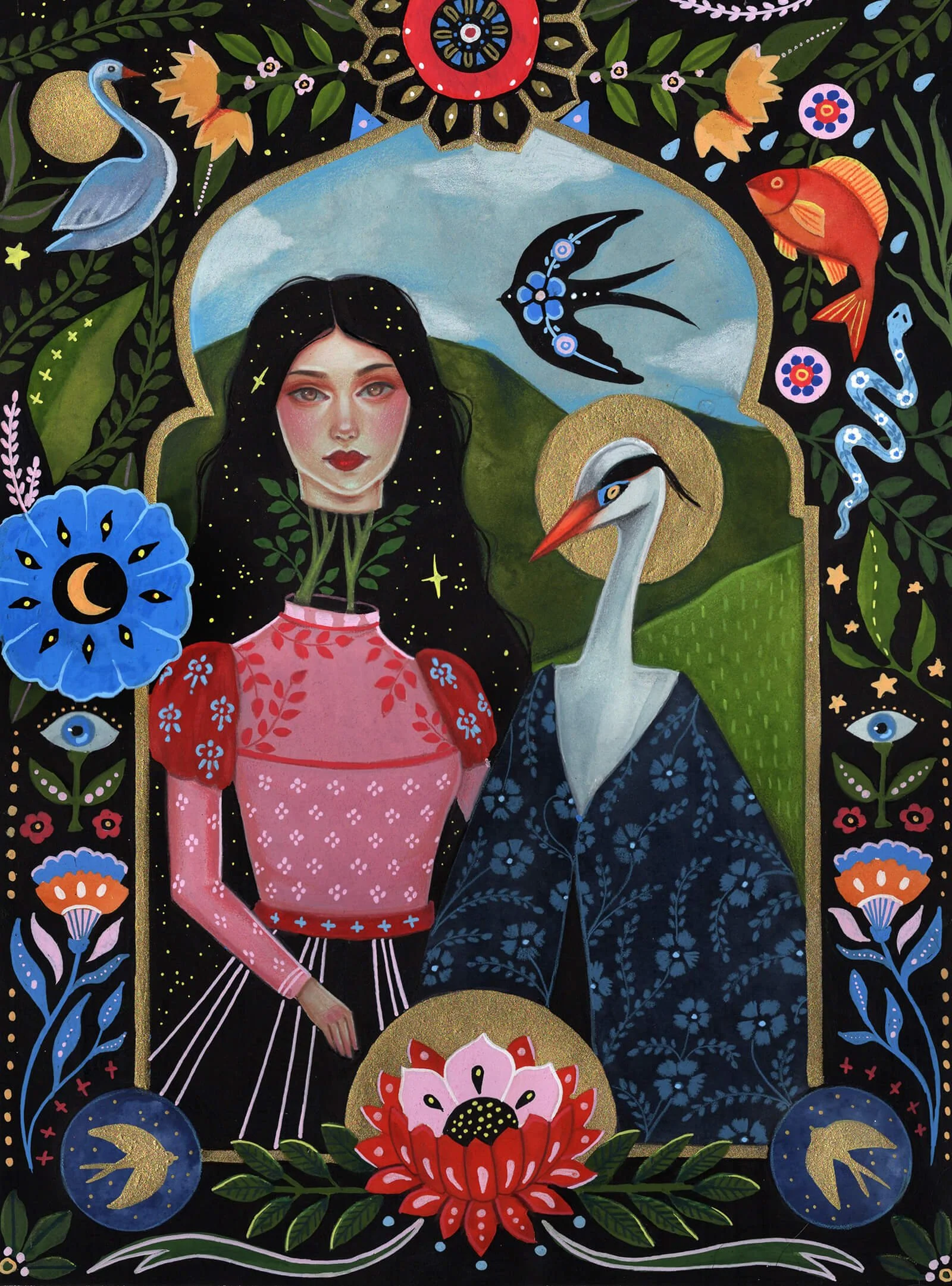
Themes of sanctuary and transformation appear often in your work. What do those ideas mean to you now?
Art has always been where I find both sanctuary and transformation. I didn't start making art to create a career and I never imagined that was even possible. I had no idea being a professional artist was even a "thing". Although I'd been making art since I was two years old (painting my mother's brand new white bedspread with red nail polish), art wasn't part of my life growing up. I thought once you got out of school, you had to get a "real job" so that's what I did. I let go of all creativity until I got very sick.
The illness pushed me to find a place to retreat and work through what I was experiencing. It took almost 20 years to get a diagnosis and answers, so much of my art became about needing to find a place to feel safe. It's also about how I could grow and change through hardship when I had literally no support system to rely on.
Sanctuary and transformation aren't just themes in my work, they're what the work itself provides me. Creating art became the safe space I needed to survive, and the process of making it became how I transformed pain into something meaningful. I am so lucky to have creativity in my life.
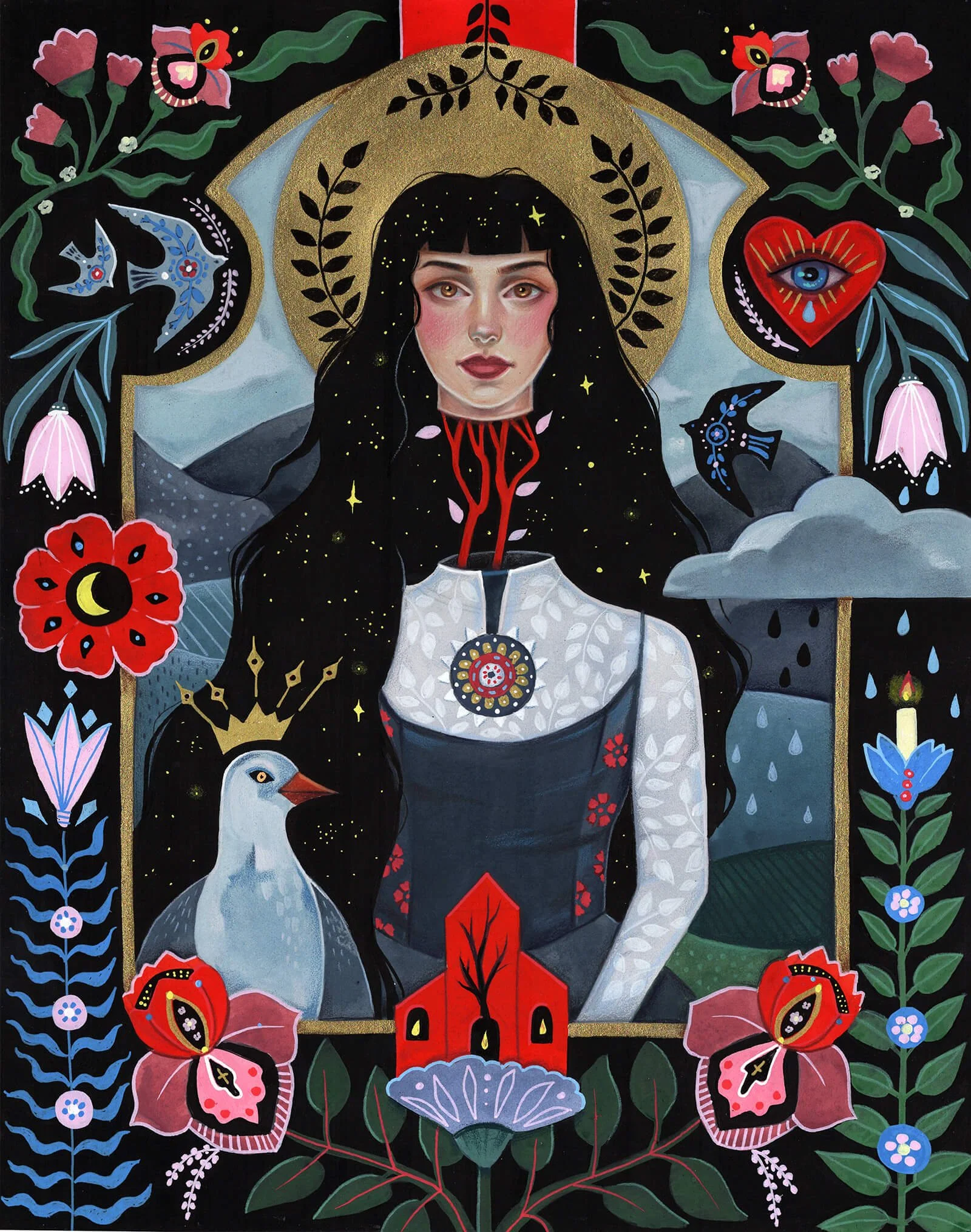
You draw inspiration from folk art, iconography, surrealism, and nature. How do these influences show up in your visual language?
From 2004-2018, I worked digitally out of necessity because I became severely allergic to traditional mediums on a life-threatening level. Digital tools saved my career, but something always felt missing. I assumed it was simply because I couldn't access traditional mediums.
In 2018, I received my first diagnosis and began treatment that allowed me to cautiously work with watercolor and gouache using a mask and gloves. I essentially started over, learning what mediums were, how they worked together, what substrates to use was far more challenging than I'd anticipated. At first, I tried recreating my digital voice in traditional mediums. Something was still missing.
I entered a strange, exciting experimental phase but I was still holding back what I really wanted to do. It killed my social media engagement and I lost 70% of my paid Patreon patrons. It was humbling. My portfolio became chaotic, looking like seven different artists.
Then in mid-2025, it clicked. I sat in the studio and told myself: Just play. No rules. No expectations. Suddenly all the missing pieces came together. My French Canadian and German/Polish heritage, bold colors, iconography, dense symbolism were all finding their place in my figurative work alongside animals and nature, with a sense of play and freedom I'd never accessed before.
These influences don't just show up in my work, they are the voice I'd been searching for all along.
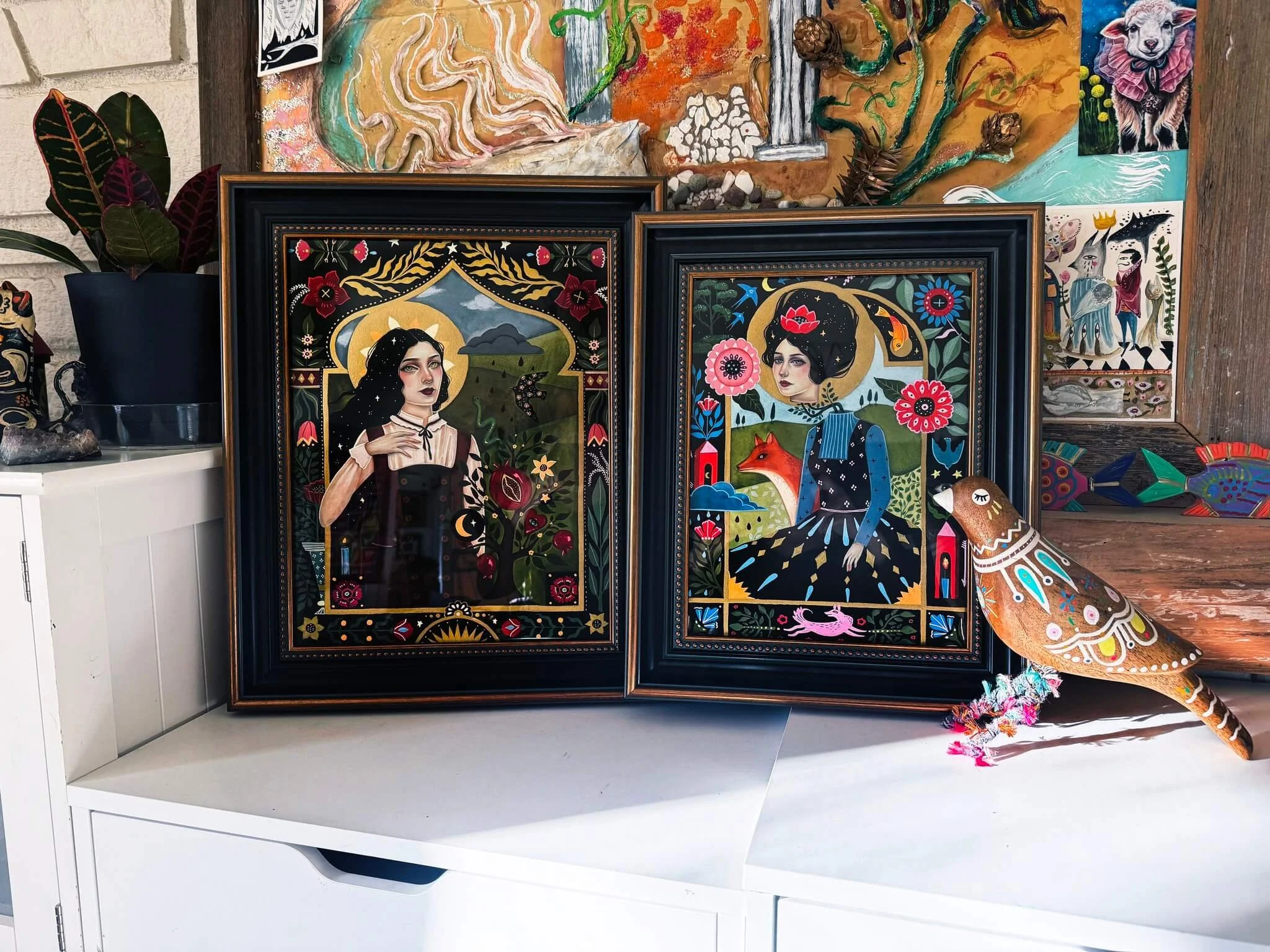
You work as an artist, curator, gallerist, and publisher. How do these roles inform each other?
Working across these roles has given me a unique perspective on the art ecosystem. As an artist, I understand the vulnerability and creative process; as a curator, I develop an eye for quality and narrative; as a gallerist, I grasp the business and collector relationships; and as a publisher, I amplify voices and create broader context.
Each role deepens my empathy and understanding for everyone I work with (artists, collectors, writers, and collaborators). Seeing artwork from all these angles helps me build more meaningful partnerships across the art world.
You have shown work in hundreds of exhibitions worldwide. What helps you stay grounded and motivated over a long career?
I've partnered with galleries and museums throughout my 20+ year career while managing three rare diseases (a combination that's taught me sustainability requires diversification).
From the inception of my career, I've maintained multiple income streams. I've run Rise Visible, a website design and digital marketing agency since 1998, and though I took two years off to focus solely on art, it fundamentally damaged my relationship with my work, stripping away joy and replacing it with bitterness and crushing stress that didn't help me create my best work.
Art is vital to my survival because it always has been, but making it my only income source, needing every sale to pay for housing, food, and supplies to even make the work, proved unsustainable for both my practice and my health. I returned to agency work, and a few years ago, Michael and I reopened Poetic Tiger Gallery which showcases new contemporary, representational, folk, outsider and narrative art from artists worldwide, as well as launching Hyperlux Magazine. We plan to retire Rise Visible to focus solely on the gallery and both our professional art careers.
Diversified income has been essential from day one. Beyond financial health, I genuinely enjoy this other work. Helping artists and building partnerships brings me joy that feeds directly back into my practice. I've learned that when I'm not making art out of desperation, the work resonates most powerfully with collectors, and that joy is what keeps me creating after two decades.
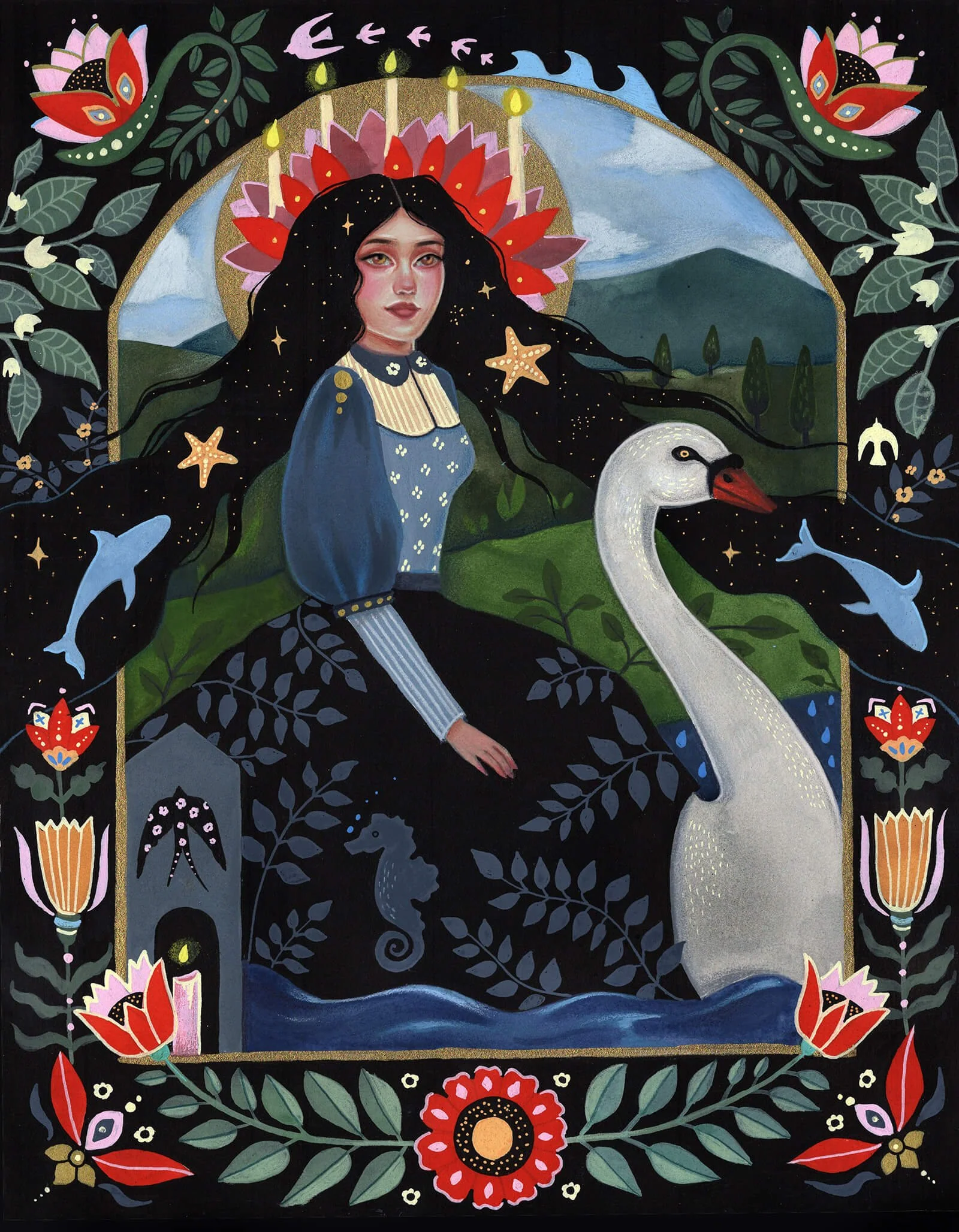
What are you most excited to explore next in your work or creative projects?
I have significant exhibitions lined up this year (I better get to work). I'm creating an oracle deck through US Games called Altar of Becoming. This will be one of many publishing projects coming up as well as my second artist book. I am also working with House of Roulx on their upcoming Roulx Redux artist trading card project with 3 pieces of mine being released.
This year at Poetic Tiger Gallery, we're curating group and solo exhibitions that I could not be more excited about. So many wonderful artists and themes. We're also sponsoring Beautiful Bizarre's emerging artist art prize for 2026 and we are working on a very special exhibition championing traditional digital artists who've spent decades pioneering this medium before AI entered the conversation. These artists deserve recognition for the groundwork they laid, and we're building partnerships with sponsors and companies committed to honoring that legacy.
Overall, this year is packed with so many things I am excited about! Thanks for asking.