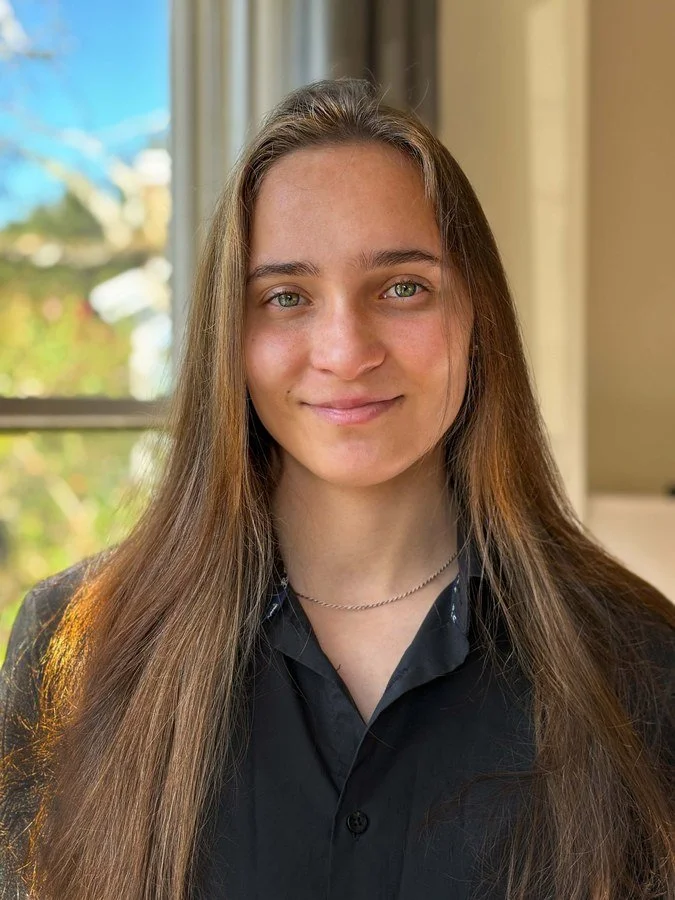
Alexis Fredericks is a contemporary interdisciplinary artist based between Boston, Massachusetts, and Savannah, Georgia. Working across embroidery, tambour beading, quilting, sewing, and installation, Fredericks creates material encounters that explore memory, cultural inheritance, identity, and belonging. Her practice investigates how objects accumulate histories and how personal and collective narratives are constructed, fragmented, and transformed. Drawing from her experiences as a queer woman adopted from Russia and raised in the United States, Fredericks examines the complexities of inherited identity and the search for connection across disrupted histories. Through labor-intensive textile processes, she transforms materials into vessels for exploring relationships between memory, embodiment, and place. Her work invites viewers to consider how objects carry emotional and cultural associations, while creating space for personal reflection and reinterpretation.
Fredericks received her B.F.A. in Illustration from the Savannah College of Art and Design in 2024 and is currently pursuing an M.F.A. in Fibers at SCAD.
Artist Statement
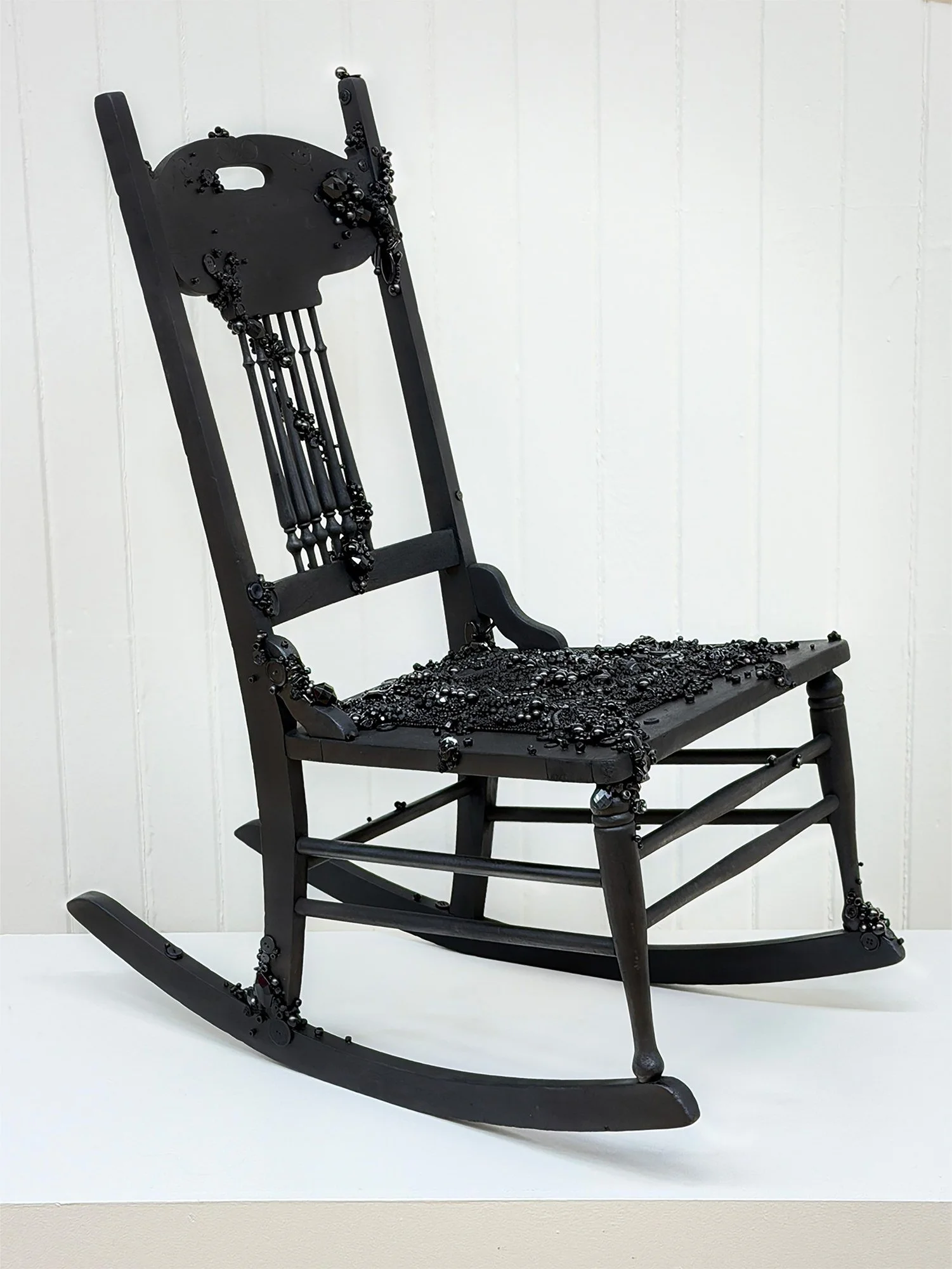
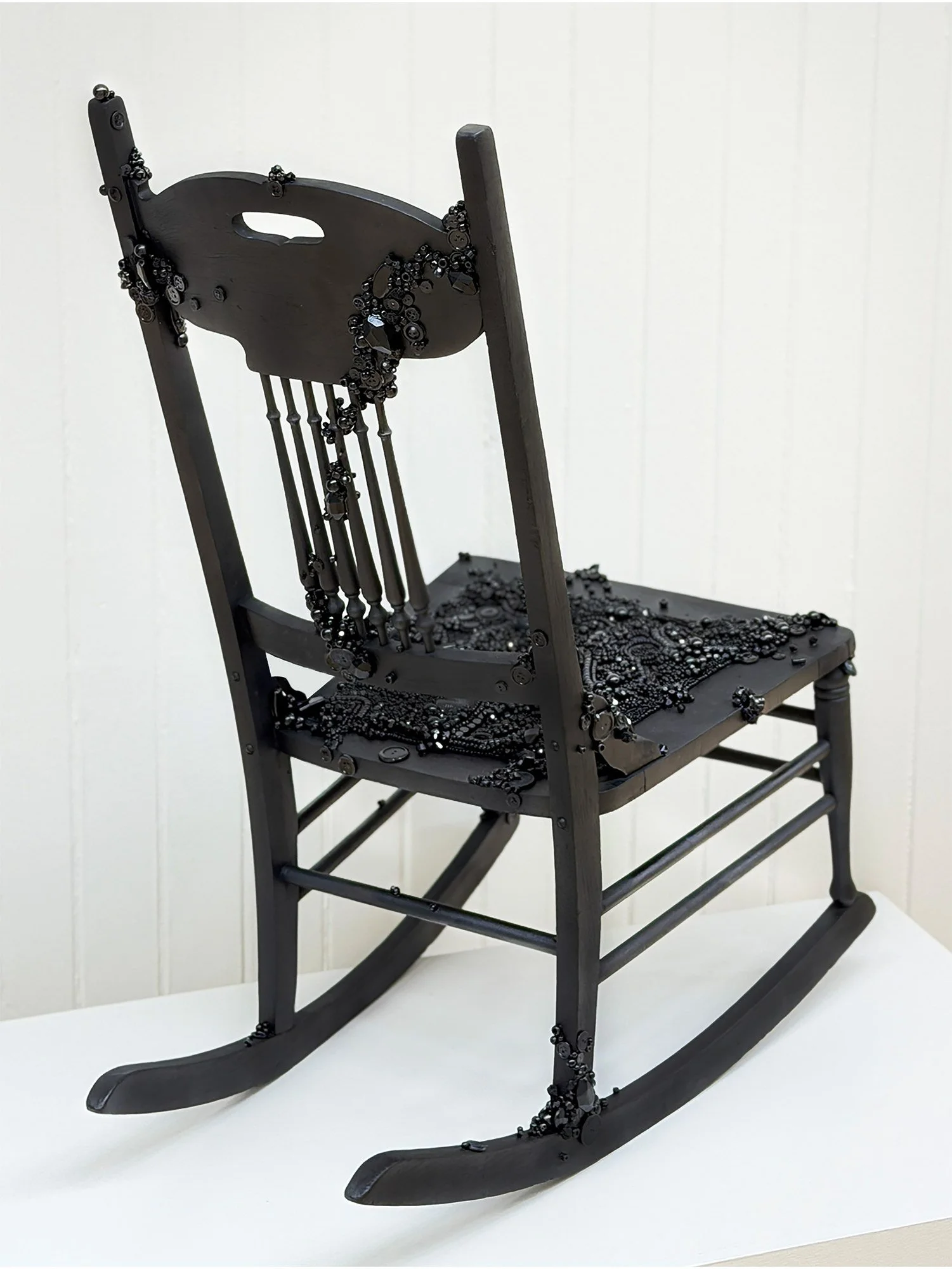
NO PLACE TO REST.
2026
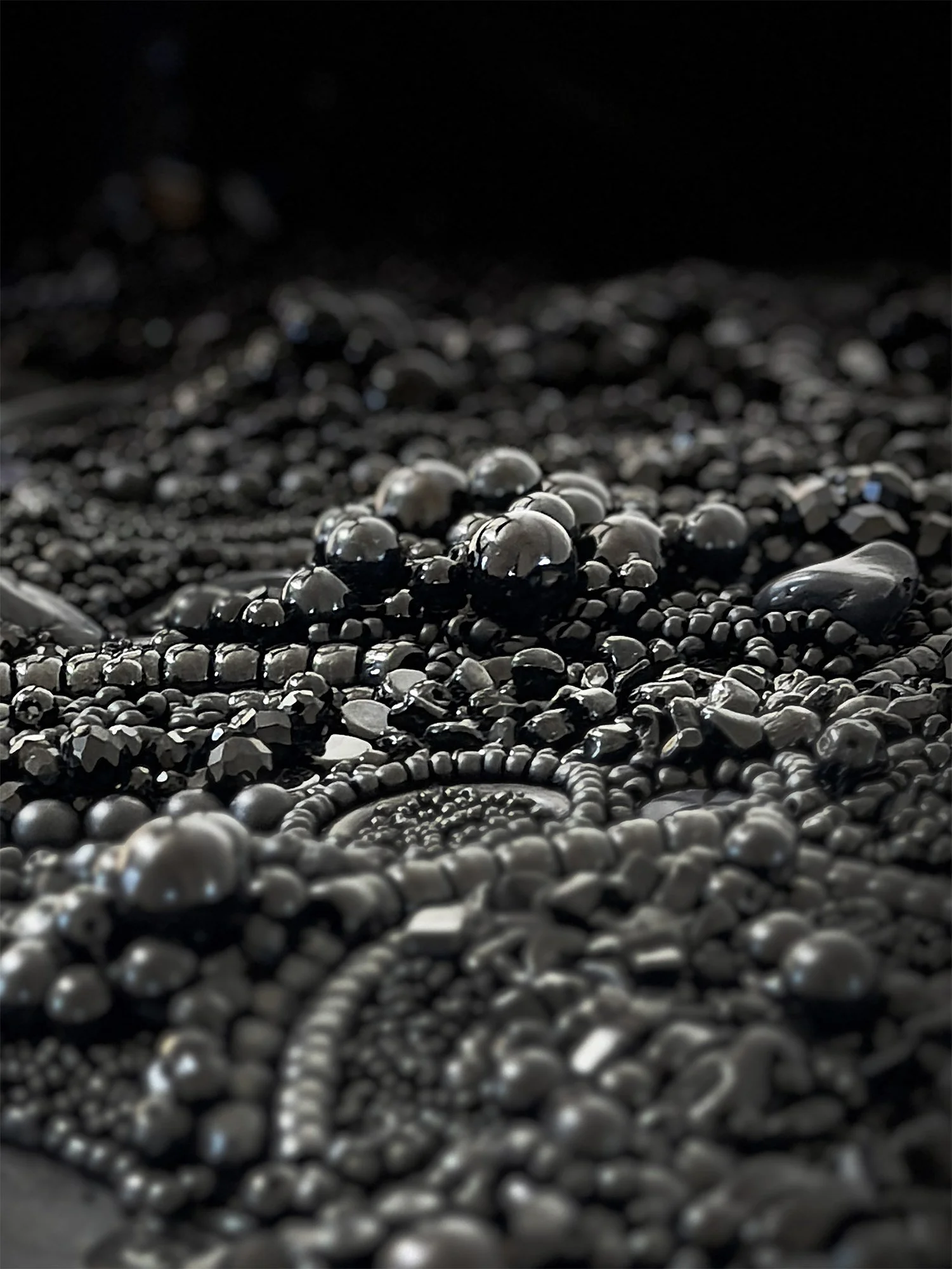
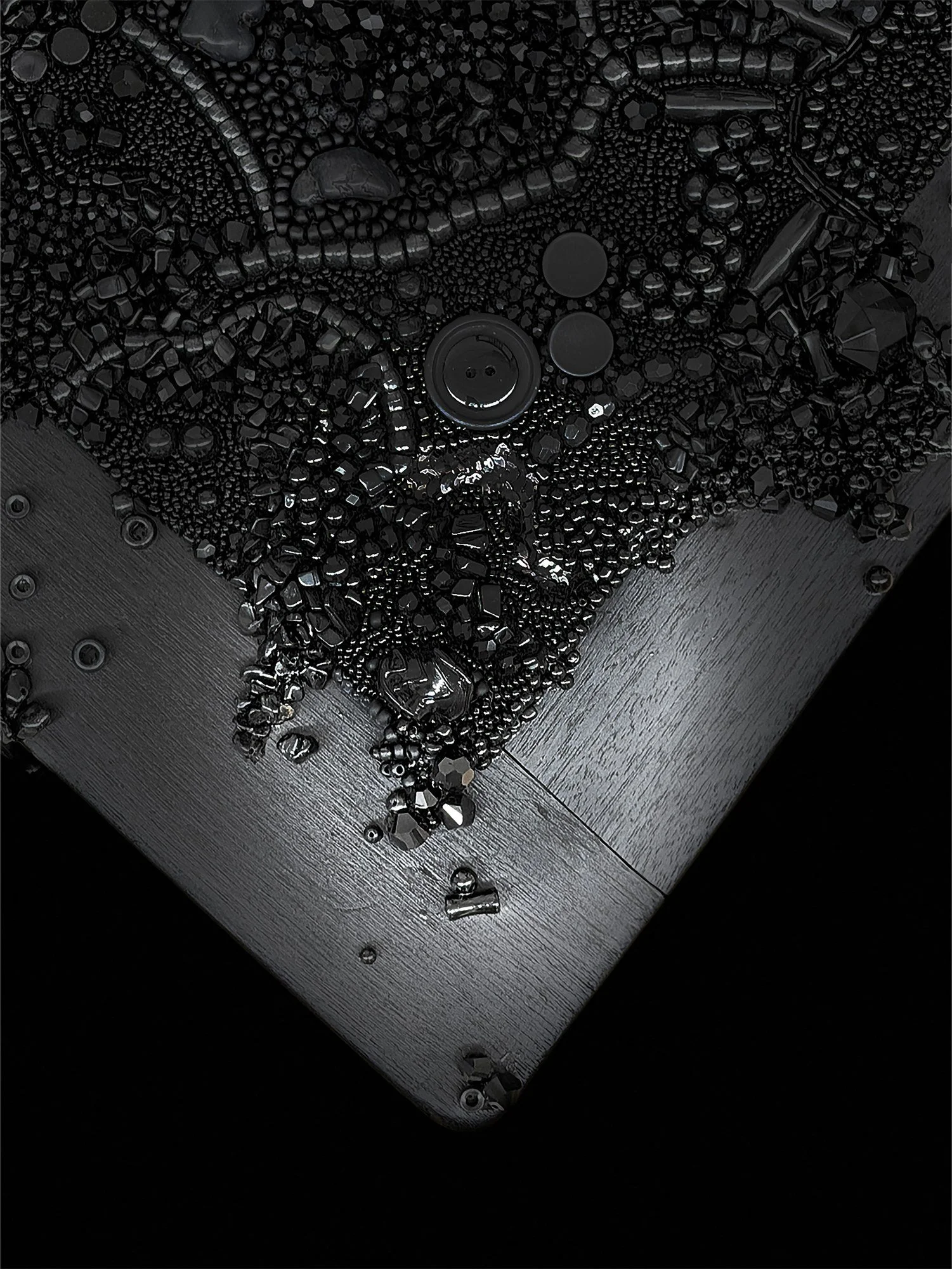
Discarded wooden rocking chair, tambour beadwork, embroidery thread, UV resin
A discarded rocking chair, an object associated with comfort, lineage, and domestic continuity, transforms into a sculptural reflection on displacement and conditional belonging. Its broken woven seat is replaced with dense black tambour beadwork, where labor-intensive embellishment becomes a surface that resists the body rather than supporting it. The accumulating beads extend beyond decoration, gradually consuming the structure of the chair and disrupting its original function. This tension between adornment and disruption reflects the imperfect, fragmented nature of personal and collective narratives and the uneasy relationship between objects that symbolize connection and the experiences they may not provide.
Painted matte black and stripped of nostalgic warmth, the chair is recast as a monument to the illusion of “home” and the cultural expectation of inherited belonging through bloodline. The work considers lineage as something unstable and non-linear, where connection is not guaranteed through origin but shaped through rupture, absence, and discontinuity.
Mini Interview
What is the central theme or concept behind your current body of work?
My practice explores multifaceted identity as relationally constructed through experience, memory, and interpretation. Working with found objects, text, and labor-intensive textile processes, I investigate how inherited narratives, fragmented histories, and material relationships shape identity and belonging. I am interested in how meaning emerges through encounters with objects, as viewers bring their own memories, assumptions, and lived experiences to their interpretations of the work.
How do you hope your work resonates with or impacts your viewers?
I want people to see something of themselves in my work, even when their experiences are different from my own. I’m interested in how objects can bring up memories, emotions, and associations that we might not expect, and how those connections can change the way we understand what we’re looking at. Ultimately, I want my work to resonate with people on a personal level and make them feel seen.
Can you share a pivotal moment that has shaped your artistic journey?
I had a pivotal moment recently when I began reading about hermeneutics and realized that it connected many of the questions I had been exploring through my practice and research. After spending so long investigating phenomenology, identity formation, and the relationship between the artist, object, and viewer, I finally began to genuinely understand how these ideas fit together through relational existence. Hermeneutics gave me a way to connect our physical encounters with the world to the interpretive processes through which we construct understanding and meaning, and come to understand ourselves and others.
What advice would you offer to emerging artists navigating today’s art world?
As an emerging artist myself, I’m learning to trust my instincts and pursue what genuinely resonates with me rather than putting pressure on myself to have everything figured out. Engaging with other artists and learning to articulate your thoughts about their work helps you understand broader conversations and develop your own perspective. Stay curious, experiment, and don’t let others, or your own assumptions, limit what your practice can become.
Are there any upcoming projects or exhibitions you would like to share with our readers?
I will be participating in the SCAD Fibers Open Studio in Savannah, Georgia, in February 2027, an event open to the public where visitors can explore graduate studios and view student work. In late May 2027, I will also present my MFA thesis exhibition and artist talk, both open to the public, as I approach graduation from SCAD. Further details about the exhibition and talk will be announced closer to the dates.