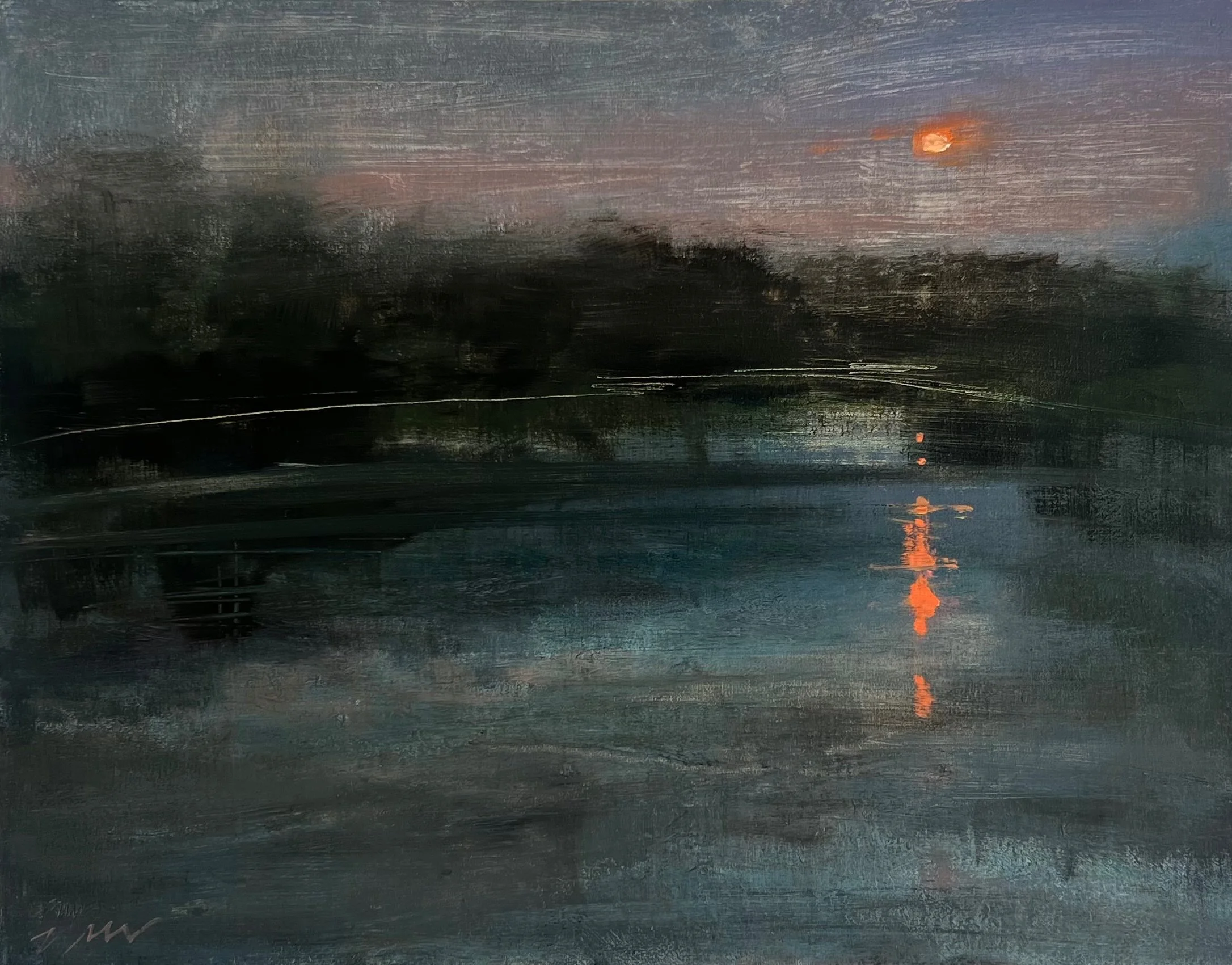
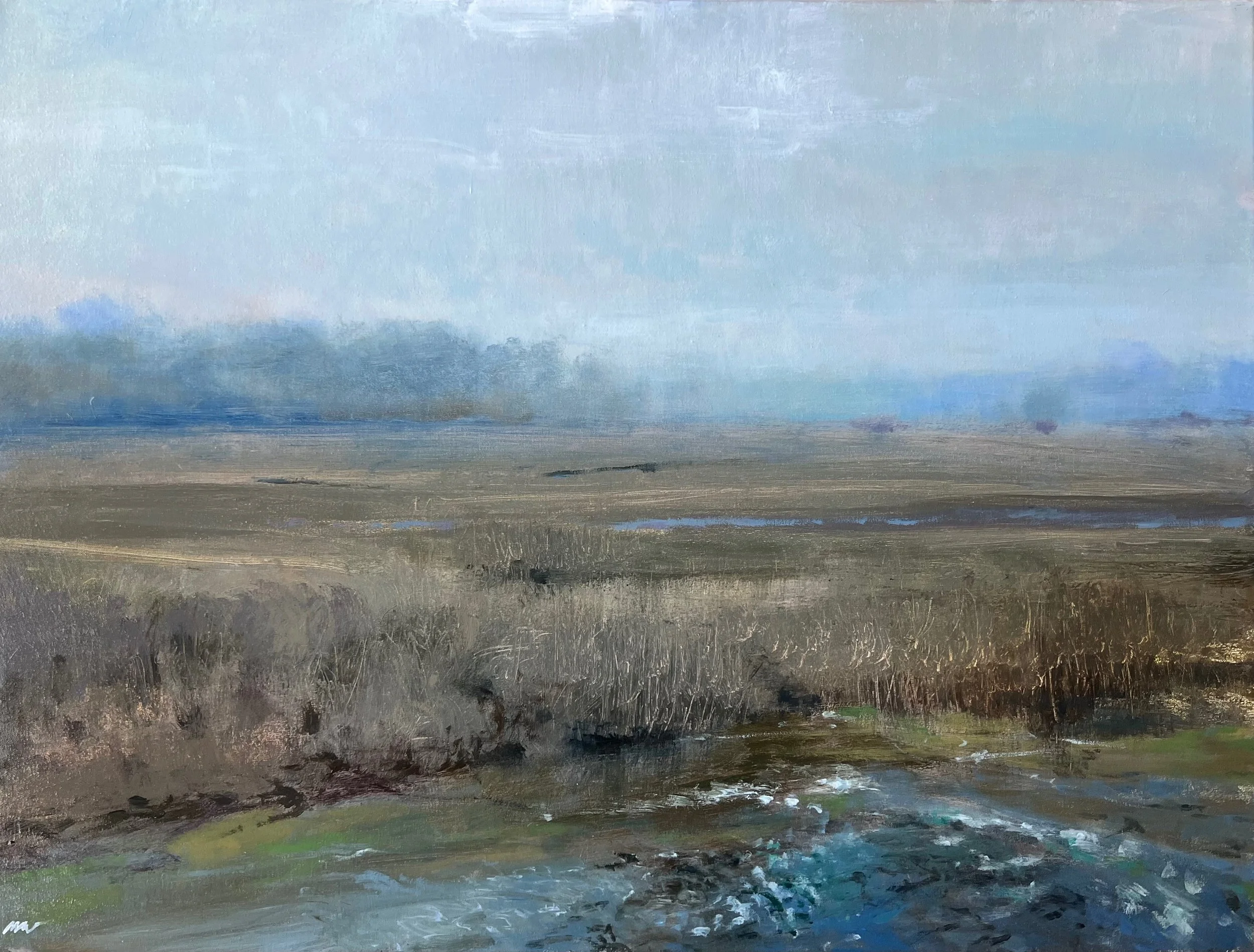
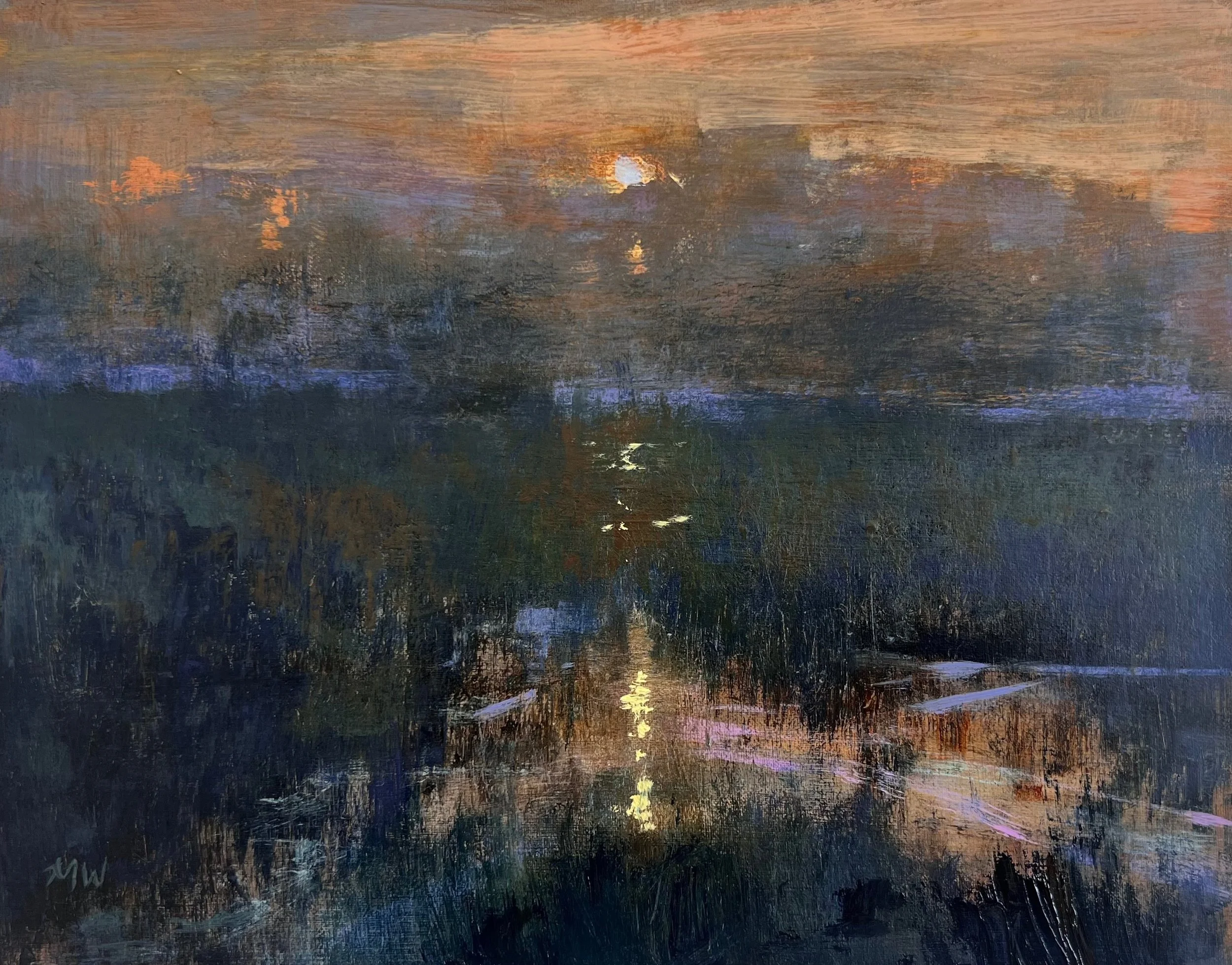
Megan Whitfield on Painting the Coast from Memory
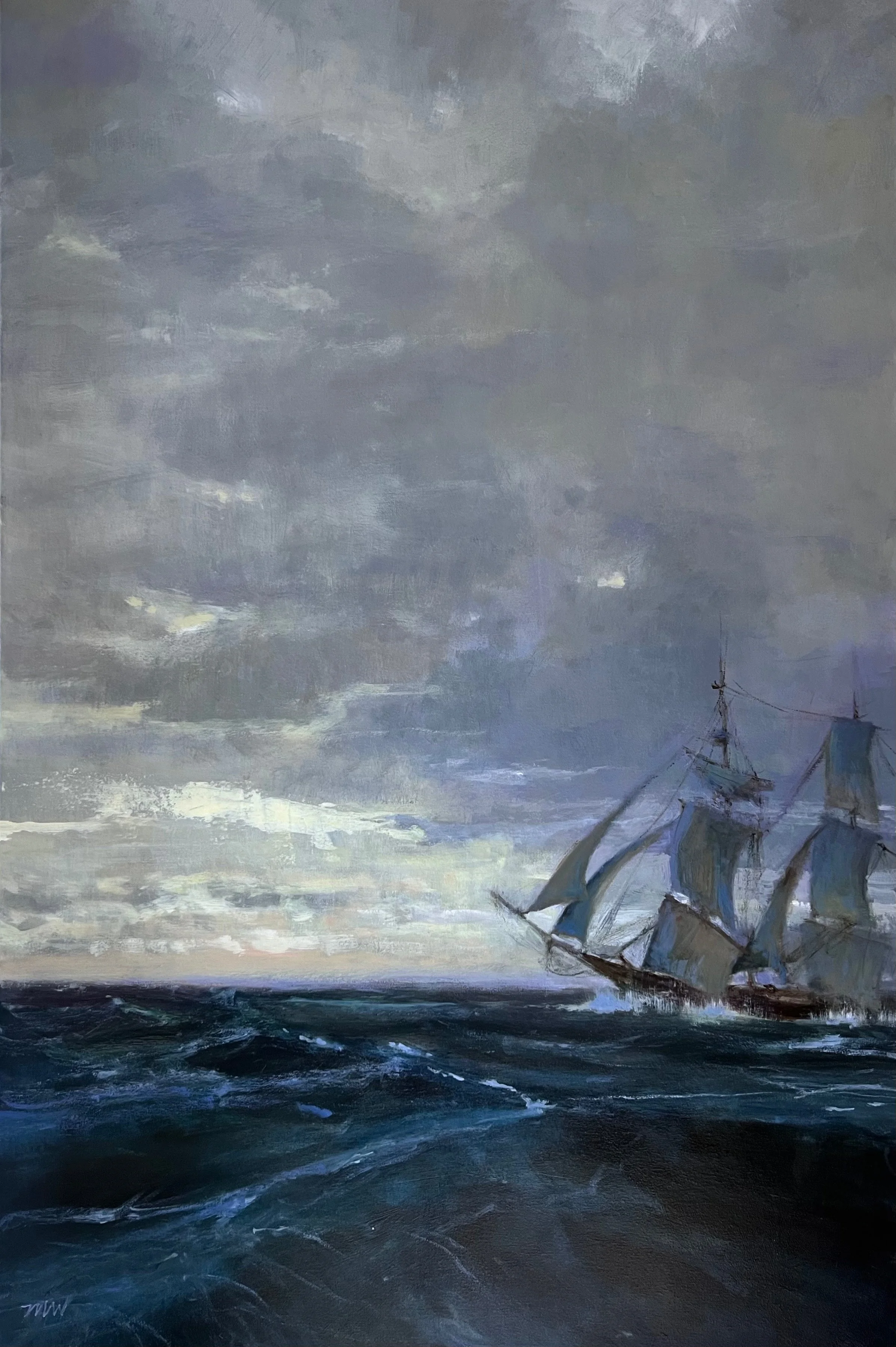
Megan Whitfield paints the coastline the way she remembers it — not always calm, but true to how it felt. The self-taught artist has followed her husband’s Navy career along one American shoreline after another for nearly two decades, and each move has left its mark on her canvases. Below, in her own words, is her story - a candid Q&A on grief, memory, and the discipline of trusting instinct over plan.
About Megan Whitfield
Megan Whitfield (b. 1985) is a self-taught representational painter living in San Diego, California. Her award-winning work has been published in Plein Air Magazine, Artist’s Magazine, and is on permanent display at Bucknell University in Lewisburg, Pennsylvania. In addition to producing highly sought-after fine art, Megan has worked as a cover artist for Hidden Shelf Publishing House since 2018. Megan has developed a love for coastal scenes, wetlands, and maritime skies, inspired by living surrounded by oceans, waterways,, and seascapes. While she grew up along the banks of the Susquehanna River in Central Pennsylvania, as the spouse of a Naval Officer, she has lived and traveled throughout the Mid-Atlantic and Pacific Seaboard for the last 18 years. Her paintings reflect a deep understanding of maritime environments and portray emotionally driven scenes of the shorelines of the rivers, harbors, and bays, which serve as the arterial waterways that give life to America. Since she began exhibiting her art in 2021, Megan has been accepted into numerous juried shows and won several awards in international fine art competitions. She is a member of the American Society of Marine Artists, the American Impressionists Society, the Maryland Federation of Art, and the National Oil and Acrylic Painters’ Society.
In Conversation with Megan Whitfield
Nature and the sea are often the themes of your stunning paintings. What are you most drawn to visually as an artist these days?
For some time, I’ve been making it a point to look for the things in nature that stand out not for obvious beauty, but for the opposite. I’m drawn to the paradox that exists in nature. For example, the dead, hollowed, and frayed driftwood spreading its splintered limbs along an ethereal and serene coastline. I’m pulled towards the rugged parts that coexist with the sublime. Over the last two years, I’ve lost three close family members and have had to learn what carrying grief around feels like. This search for the paradoxical beauty around us is a clear picture of experiencing deep loss. So, in many ways, this is how art has helped me organize and carry that grief.
You’ve lived along so many different coastlines as a Navy spouse. Is there a particular place or body of water that left the biggest mark on this body of work?
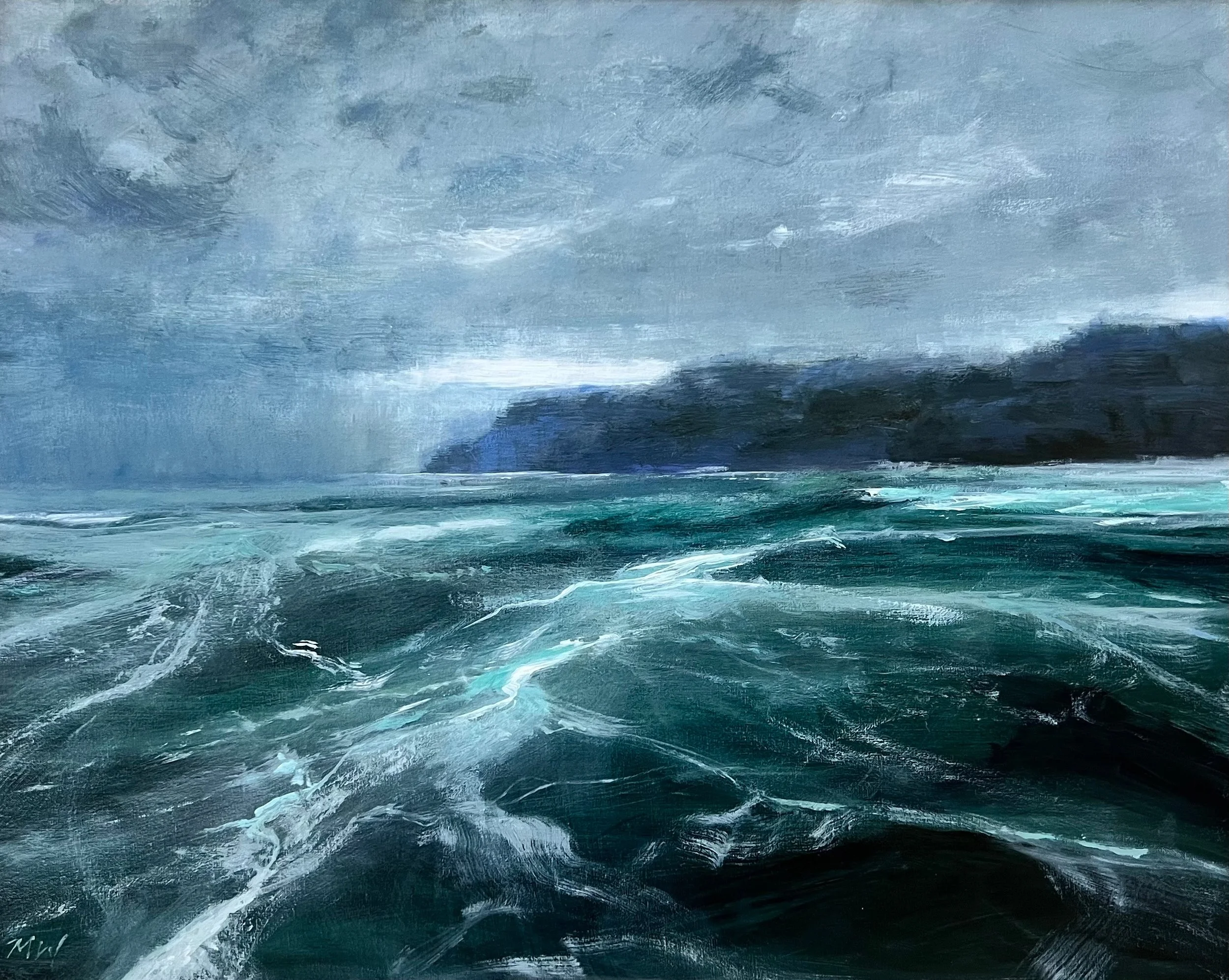
Military life is hard, but one of the brightest silver linings is living near the water. From 2016-2018, we were stationed at US Coast Guard Training Center Cape May in Cape May, New Jersey. We arrived in mid-December, with the elements of incoming winter fully upon us! There is an area in West Cape May called Sunset Beach where you face west towards the Delaware Bay. We pulled up to the parking area near Sunset Beach, and as we opened our doors, the wind nearly ripped it from the hinges. It was high tide, and the waves were crashing with white caps all throughout the water to the horizon line. While it wasn’t what many would say a warm welcome, it was the beginning of a relationship to a place that would teach me so much about beauty, patience and perspective.
As a Tonalist painter, you describe your work as rooted in memory and emotional connection rather than direct observation. Can you walk us through what that process actually looks like, from first impression to finished painting? Do you take photographs or work from memory?
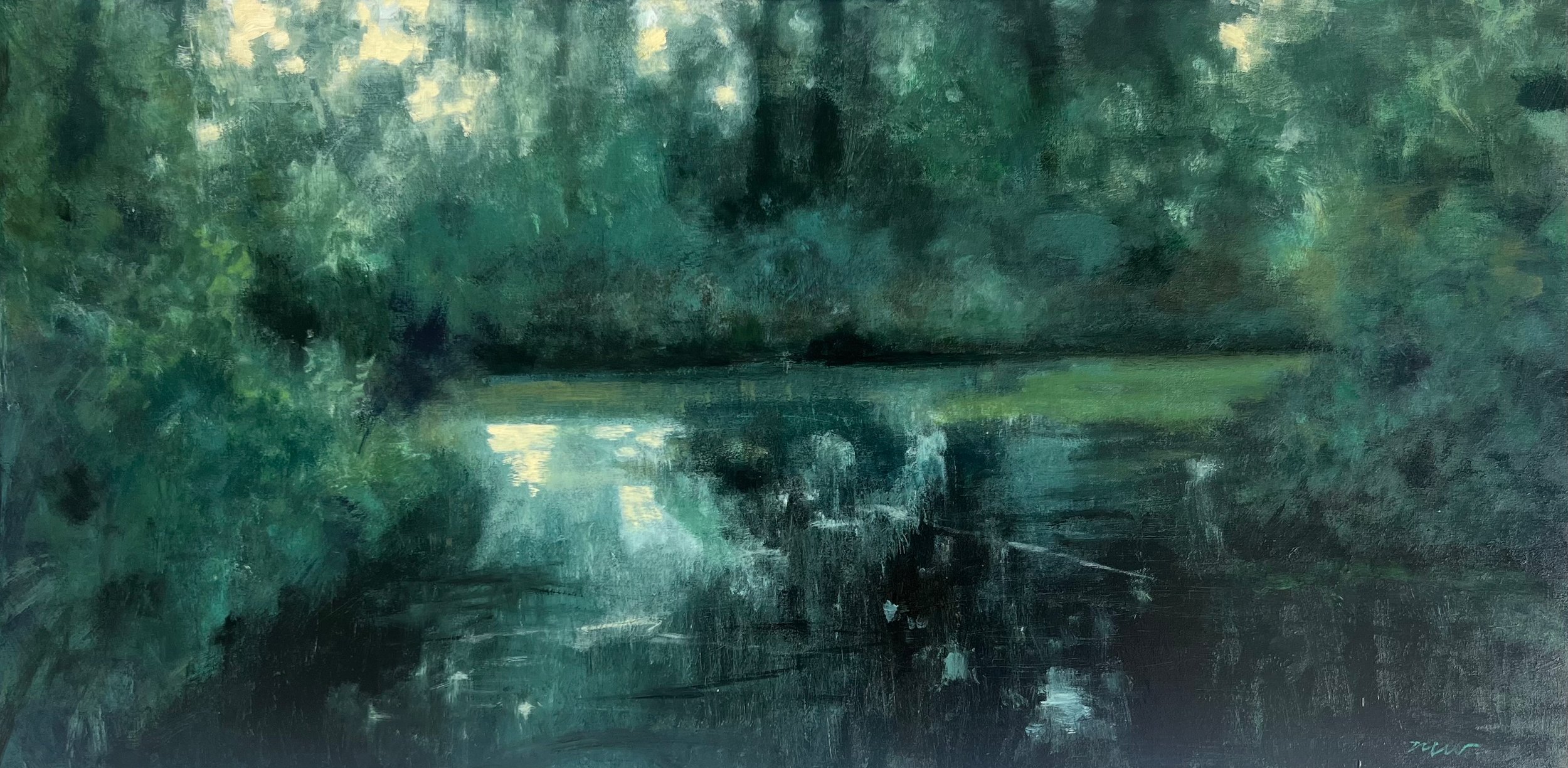
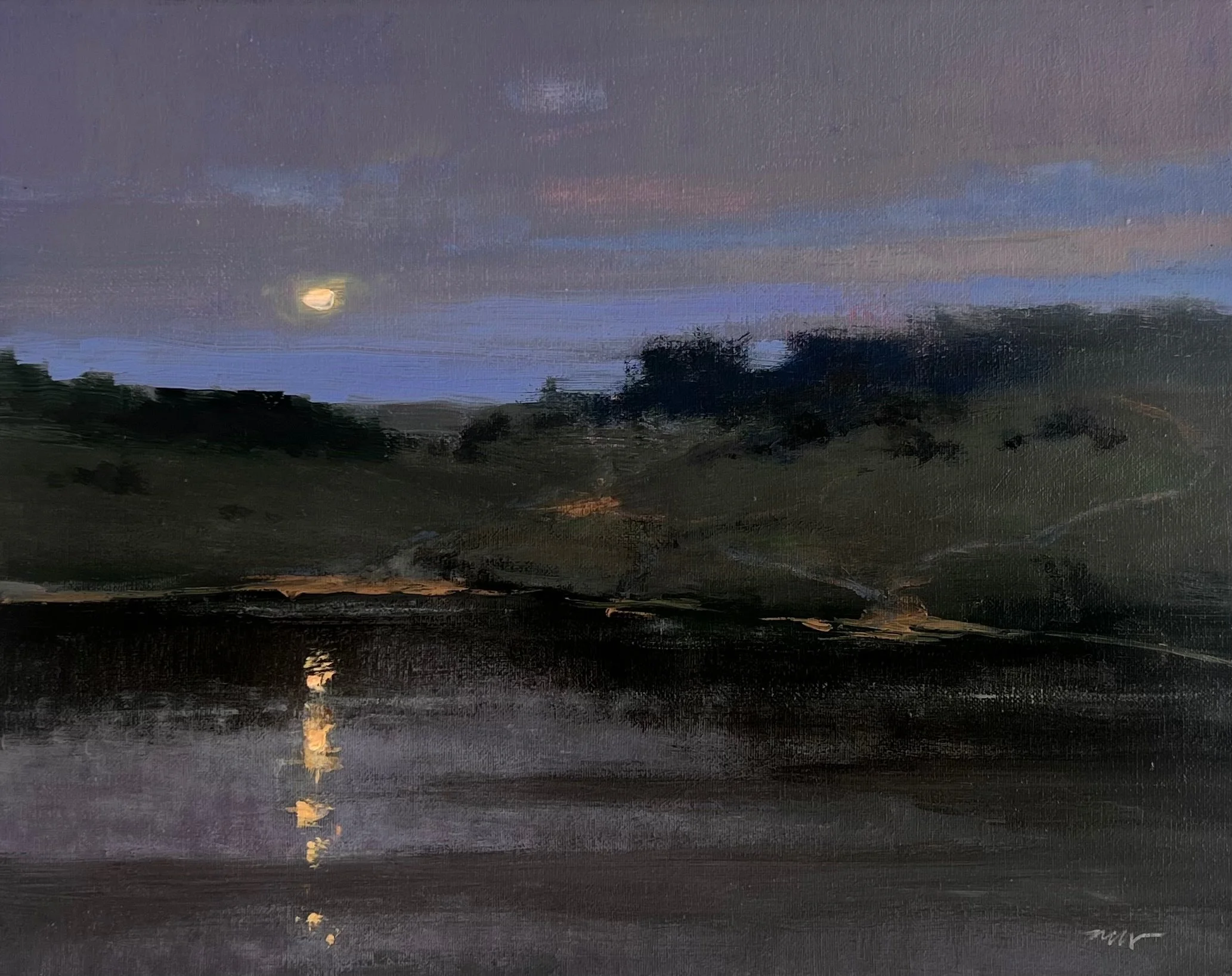
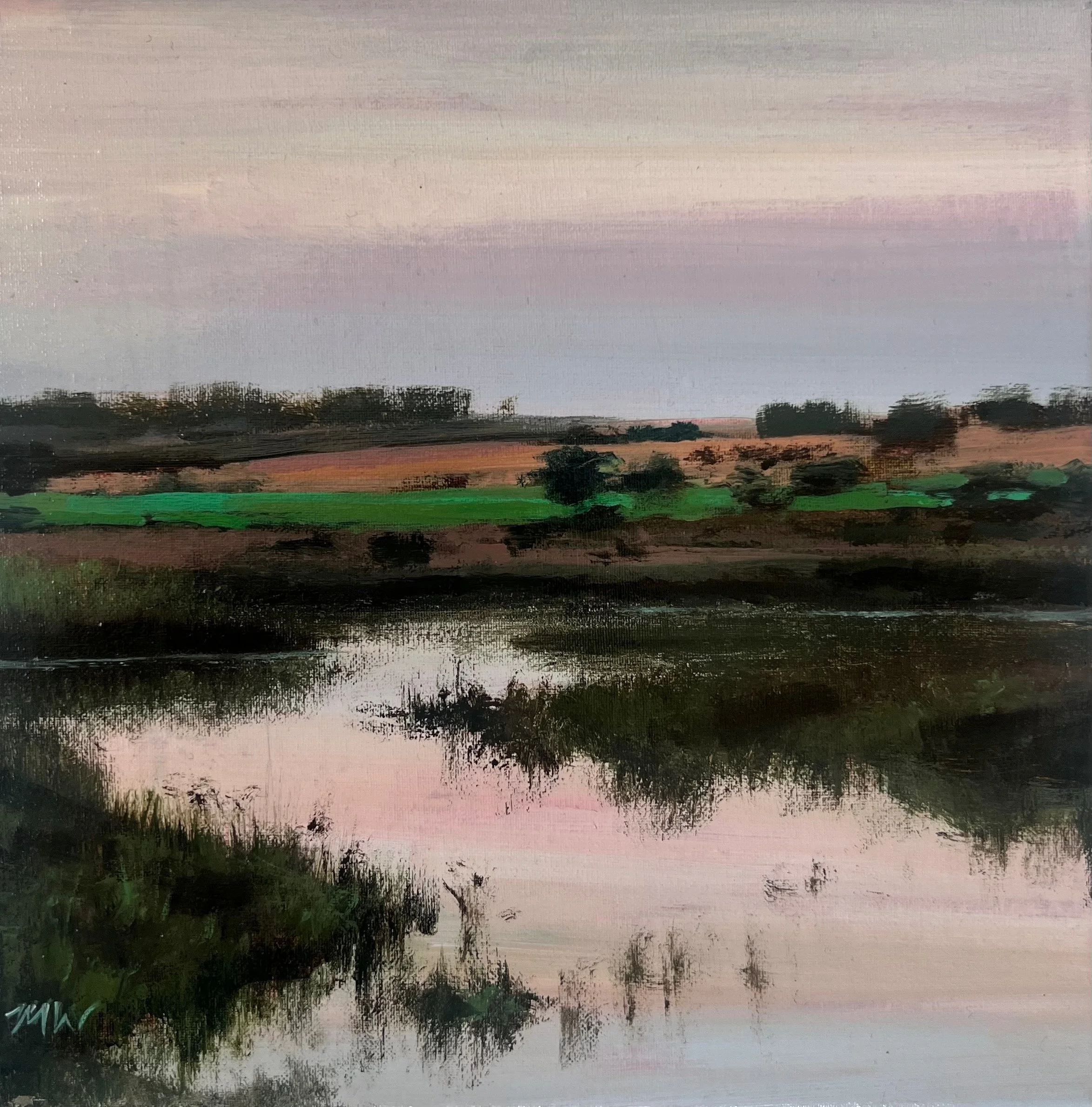
I like to say that I’m just “winging it” most of the time. Because I paint without photographic references, I rely heavily on my memory and imagination. My process is quite open and much like the creative process for writing. I usually come into the studio with only a pre-determined color palette or color theme. From there, I will put down my underpainting wash of color using slow drying acrylic paints. I prefer to use warm temperature hues like Indian Yellow, Transparent Red Iron Oxide and Quinacridone Magenta in a loose patchwork for the underpainting. From there, brushwork and watermarks will guide me in seeing a direction for the composition. Often, I’m inspired most by this first part of the process. The underpainting will trigger a memory or feeling which leads to the overall tone and energy of the painting. I try to stay very flexible during the painting process. The most difficult stages of a painting tend to be in the middle once you’ve laid down your initial idea and block in the colors and shapes. This is always a fork in the road where I must decide what the painting really needs to be. At this stage, I find it crucial to stay open and courageous to follow my instincts. Sometimes this means taking the painting into an abstract direction or tightening things up and focusing on realism. Generally, I have no notion on what direction the painting will go in until I reach this stage.
You’re self-taught, which is incredible. What inspired you to start painting in the first place, and what was the learning curve like?
I was so fortunate to grow up in a house that was filled with fine art and books. My mother was an art enthusiast who loved to paint but also curated our home with fine art on the walls and art history books stacked in different corners. She was intentional about having these art books and paintings at eye level. I remember being four years old and carrying around a small 5”x7” framed print of Caravaggio’s, “The Lute Player” which my mom so perfectly placed next to an actual lute. Along with the Caravaggio print, I would travel around the house with my two favorite books, one on Degas and the other on Cezanne. These books were small and had a gold leaf book cover, which was perfect for my tiny Magpie hands that loved anything that was shiny and glamourous. My dad was a writer and newspaper columnist that was always working towards a deadline. I was able to see front and center what constructing a newspaper article looked like with all the red ink and drafts that went along with it. From an early age I learned that the creative process is intimate, unique and sometimes feels like a pressure cooker. My parents were sure to invite me into their creative worlds and gave me the space to find my own place. I can’t remember a time where art was not a part of me. With that said, I had years where I stifled my creativity. When I became a new mom, I felt that I had to tuck that part of me away and appreciate the art of others rather than my own. I had three children within 4 years and was a military spouse dealing with deployments and routine moves. Once my kids entered Elementary school, I started to feel my creativity blossom again with decorating my home and baking cupcakes for school functions. But the calling back to making fine art was becoming stronger. Things came to a head in 2021 when life was in the thick of COVID-19, and the world stopped being what it once was. It was then that I had the epiphany that I could no longer separate myself from being an artist. I owed it to myself, but also to my children to dedicate myself to the life of being a painter. Rather than keeping the role of being a mother separate from being an artist, I merged them together. I wanted my kids to see me paint, from start to finish. I wanted them to see me study, to hear me talk about art and how I’ve failed and succeeded. Inviting them into this world was the only way I could move forward. I struggled with feeling behind, feeling like I had missed the boat. During the early periods of painting again, I would feel physically and mentally exhausted after a painting session. My therapist at the time helped me to understand that what I was feeling was that my skill had not caught up to what was inside my heart. I had spent years prior, logging images in my mind, future paintings and works. Now that I was painting again, my technique couldn’t match what I saw in my mind. This led to an overwhelming fatigue that felt bone deep. She encouraged me to continue my plans and work every day, pushing myself forward and with time, my hands would catch up to my heart.
Between your fine art and your cover work for Hidden Shelf Publishing House, do those two practices influence each other at all, or do they live in separate creative spaces for you?
Creating book covers is like an inverted process compared to creating paintings. My process for covers looks so different from what I do when painting. It’s very regimented and planned. First, I always read the manuscript. I need to know and understand the book well enough to translate it visually, with sensitivity to big and small details. I work with an incredible graphic designer, Rachel Wickstrom, who has become such a trusted creative partner. We bounce ideas back and forth and chip away over the course of months to create our covers. The process is much longer than my painting sessions and requires a lot of brainpower. When creating a painting, you don’t have to consider text or typography. With a book cover, there must be a balance between the visual art and the text. They need to work together, and sometimes that means creating something that feels unfinished or breaks the standard rules of composition. I’ve found that creating in this different space has made me more comfortable exploring my imagination, finding the focal point of a painting,, and pushing boundaries. I love to push boundaries!
What do you hope someone feels when they stand in front of one of your paintings?
I hope people feel emotions they've tucked away. That they feel transported to something that they had long forgotten; to a place that they had locked away in their memory. I hope they feel understood.