

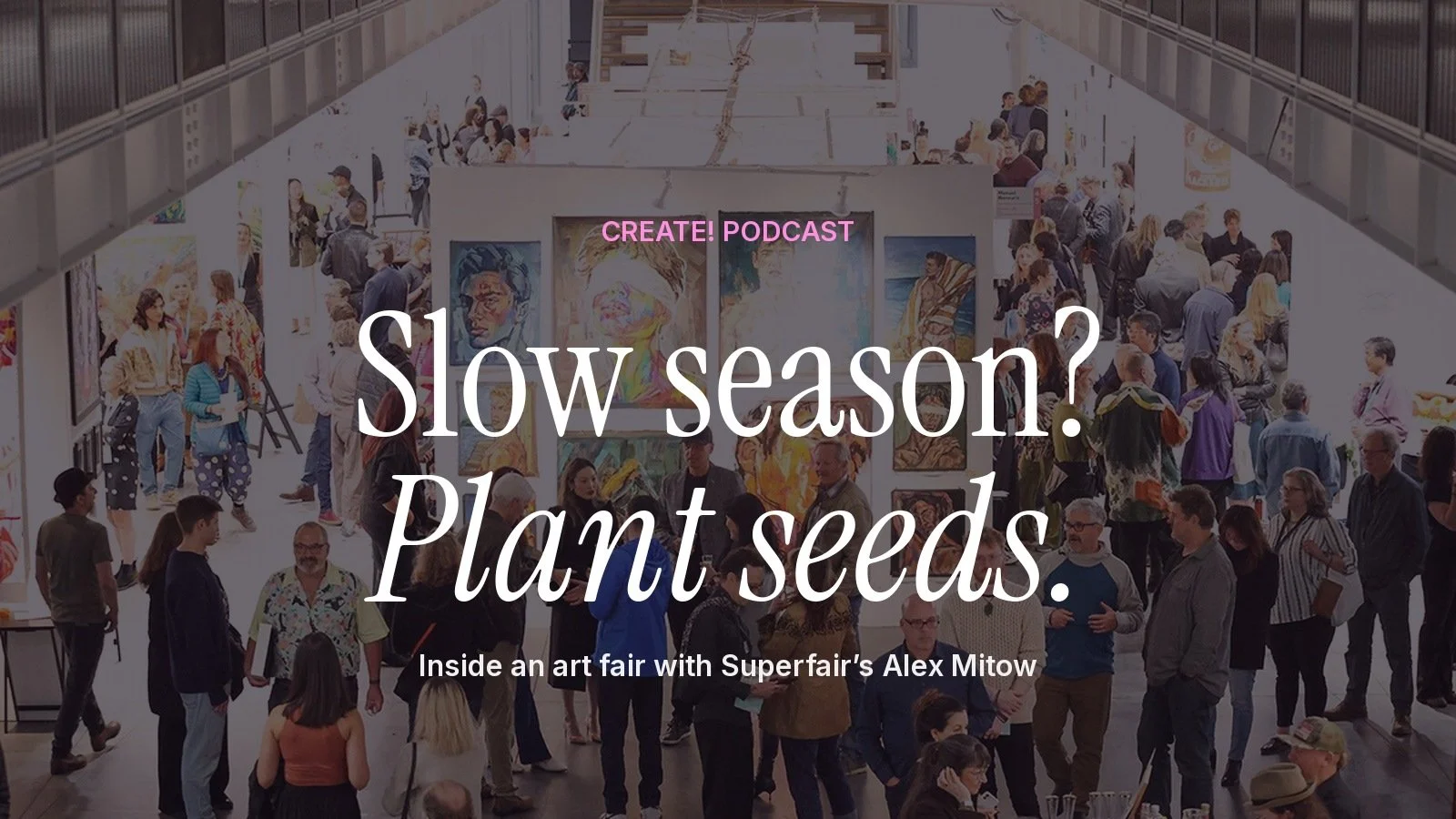
Slower seasons are part of every creative career. They can also be the best time to plant seeds for what comes next.
That idea shaped my latest conversation with Alex Mitow, founder of Superfair. Alex has been producing art fairs where artists represent themselves for 12 years, and we have worked together for almost 10 of them. In this episode of the Create! Podcast, we talk openly about what this year has been like for both of us as business owners. Then Alex takes us behind the scenes of running an art fair, so you can see where the money goes and choose the opportunities that fit your work.
A slower year says nothing about your work
Alex opened with honesty. In his conversations with other business owners, he keeps hearing the same thing: this has been one of the tougher years. Costs are up. Trucking is one of the biggest expenses in the art fair world, and income has stayed flat for many people.
His message to artists is simple. If sales have been quiet, look at the bigger economic picture before you question your paintings. The work you are making still matters.
I shared my side too. Create! Magazine turned 10 this year, and it was a steady year for us more than a growth year. I reminded myself that success moves in seasons, and 10 years is only the beginning. If this year asked a lot of you, you are in good company. We get to adjust, pivot, and keep going.
Why someone starts an art fair
Alex describes Superfair as a small business that does very big things. He started it after seeing an imbalance in the art market. Many artists wanted and needed to sell their work. Many people wanted original art on their walls and felt out of place in the traditional gallery world. Superfair was built to bring those two groups together.
The numbers behind a fair may surprise you:
One Superfair show costs $250,000 to $350,000 to produce.
Venues alone run $30,000 to $180,000 for a week.
With six shows a year, production costs come close to $2 million.
Superfair sells booths and takes zero commission. As Alex put it, that means the fair answers to the artists. Its one job is to bring in people who are ready to buy.
The company also went 21 months without a fair during the pandemic. The team shifted to education, launched a podcast, and kept going. Alex is in this for the long run, and that matters when you are choosing who to partner with.
Your work is uniquely yours
One of my favorite moments was Alex talking about comparison. You could paint a sailboat, he said, and it would be different from every other sailboat painting in the world. Whatever is happening online, your work carries you in it.
That is also why showing work in person is so powerful right now. Our feeds are crowded, and what worked on Instagram a few years ago keeps changing. In a room, a visitor can stand in front of your painting, focus, and talk with you. I felt this recently in a museum gift shop, where I found things I never could have thought to search for online. Some things you only know you love when you see them.
Alex also shared a curation tip for your booth. Show a cohesive body of work with a range of sizes and prices, and lead with what excites you most right now.
How to choose the right fair
Artists have more options than ever. Here is how Alex breaks them down.
Indoor and outdoor fairs. Outdoor fairs cost less, and many visitors are passing through on their way somewhere else. Indoor fairs cost more because of the walls, lighting, and venues. Visitors choose to walk in the door, so they arrive ready to shop. Alex shared that 90% of Superfair attendees say they came looking for art to take home, and 60 to 70% of them buy something.
Booth fees and commissions. Superfair charges a booth fee only. Artists handle their own sales and keep their buyers' contact information. The Other Art Fair charges for the booth and takes a partial commission, and it handles transactions for you. Affordable Art Fair is built around galleries, and artists are now joining as collectives. Each model suits different artists. Alex encourages you to try more than one and see which you prefer.
Size. Alex finds that 40 to 120 exhibitors gives visitors plenty to discover and keeps the experience easy to take in.
Above all, choose a fair because you believe in its mission, its city, and how it markets the show. Alex sees every fair as a partnership between organizers and artists. In his words, "If we don't have you, we're just a big empty room."
Keep building, even when it feels quiet
Alex quoted one of his favorite writers, Hunter S. Thompson: "Buy the ticket, take the ride." Do your homework, then commit and stay open to learning.
Here are a few ways to keep your momentum in a wobbly economy:
Offer smaller works and multiples alongside your larger paintings, so more people can take your work home.
Treat every sale as the start of a relationship. Fifty or one hundred new collectors this year become the foundation for the years ahead.
Use quieter months to apply for grants and new opportunities.
Keep showing your work. Sales continue even in slower seasons, and each one counts.
Alex also reframed what success at a fair looks like. Breaking even is a real win, because the people who bought your work now live with it every day. They come back, and they tell their friends. He thinks of a fair as a trampoline that launches you to the next thing.
I broke even at my first fair and was so happy about it. At my recent studio sale, most of the buyers were returning collectors. Every show, every post, and every conversation feeds the bigger vision you have for your life as an artist.
Superfair Black Friday offer for artists
Superfair has made some changes with artists in mind. Furniture now comes with every booth, most shows run three days, and booth prices have come down.
Through Friday, November 27, 2026, artists also receive:
$750 off any booth at your first fair
$375 off a second fair
An extra 10% off when you pay in full upfront
Superfair cities include New York, Washington DC, Boston, Philadelphia, San Francisco, and Houston.
Book a 15-minute discovery call with Alex to claim the offer or talk through your next career move.
Current open calls from Create! Magazine
Winter 2027 Print Issue, curated by Deep Space Gallery. Be our next cover artist. Deadline: November 30, 2026. Apply here
The Way of the Mystic, an in-person exhibition I am curating at the Arts League Gallery in Philadelphia, May 22 to June 26, 2027. Details and submissions
Listen to the full episode
Find this episode of the Create! Podcast on Apple Podcasts and Spotify. You can also explore Alex's podcast, The Artist Business Plan.