Many artists leave art school having read a great deal about meaning and very little about method. The instruction to go make something and figure it out produces plenty of ideas and almost no technical vocabulary. This episode of the Create! Podcast is for anyone who recognizes that gap in their own training.
Alonsa Guevara is a Chilean American artist whose work blends observation and imagination into images that read as a meditation on the cycle of life and the power of nature. She holds an MFA from the New York Academy of Art and a BFA from the Pontifical Catholic University of Chile, and her work has been exhibited in China, the United Arab Emirates, Mexico, Denmark, Argentina, Chile, and across the United States. Her paintings have been published in Forbes, Time Out New York, VICE, and The National News UAE. She is also Co-Owner of Bay Ridge Art Space in New York and Revival Murals in Los Angeles.
From Conceptual Study to the Craft of Painting
Guevara began oil painting at twelve, but her undergraduate program in Chile was oriented toward conceptual work rather than technique. Every painting required a justification. Everything she made needed a stated reason behind it.
"It wasn't so much about the practice, the craft itself. And I felt like I needed that," she says. "I needed to see somebody paint. I needed to meet real artists."
That need brought her to New York and to the New York Academy of Art, where she watched an instructor mix color and work through a painting step by step for the first time. Representation and gallery interest followed.
The Comparison Problem in a Room Full of Talent
Arriving in a graduate program surrounded by highly trained painters produced a familiar difficulty. The artist describes measuring herself against everyone around her and coming up short.
"If I thought I had a superpower, well, let me tell you. There are many people with superpowers," she says.
Her response was volume. More classes, more training, more hours at the easel, and steady improvement in the two skills that underpin everything else: observing and listening.
How to Keep Learning
Graduate programs often cost thousands of dollars, and not everyone receives a scholarship. Asked what an artist can do without that access, Guevara points to a sequence anyone can begin this week.
"The basic information is in learning to look, to observe, and then you have to practice and copy," she says.
Copying a photograph or a masterwork trains the eye to notice patterns in color mixing and construction. Repeating a leaf enough times teaches the leaf. That accumulated visual knowledge becomes available later, when an artist wants to invent rather than reproduce. As the painter puts it, that library of information stays in your head, and it lets you make things up because you have already painted them before.
She also recommends seeking out working artists directly. Mentorship, small group classes, assisting in a studio, and paid online courses all shorten the distance between a technique and the person who can demonstrate it.
The Practice Cycle
Guevara works through a repeating arc that she describes as play, observe, practice, imagine, and flow, then back to play again. Each stage feeds the next. The observing and copying stage builds the reserves the imagining stage draws on, and the cycle restarts rather than ending.
Color Temperature and the Difference Between Flat and Alive
Artists come to her mentorship program with a specific complaint. Their work is recognizable, but something reads as flat. Skin sits on the surface. Space fails to open up.
Often the fix is not more rendering. It is temperature.
"Changing the temperature in your painting and making those shifts makes the painting really feel alive," she says.
Alongside temperature she teaches saturation and neutralization, edge control between soft and defined, and value structure from shadow to light. Each is isolated so a painter can focus on one variable at a time rather than managing all of them at once.
Intuition as Knowledge
The phrase "I paint intuitively" often gets heard as painting at random. Guevara rejects that reading.
"Intuition is knowledge that we have inside of us that tells us what to do," she says. "The more we learn, the more powerful our intuition is. It's experience."
Under that definition, study and instinct stop competing. Everything an artist learns and repeats settles into the place where fast decisions come from.
Inside Alive Nature
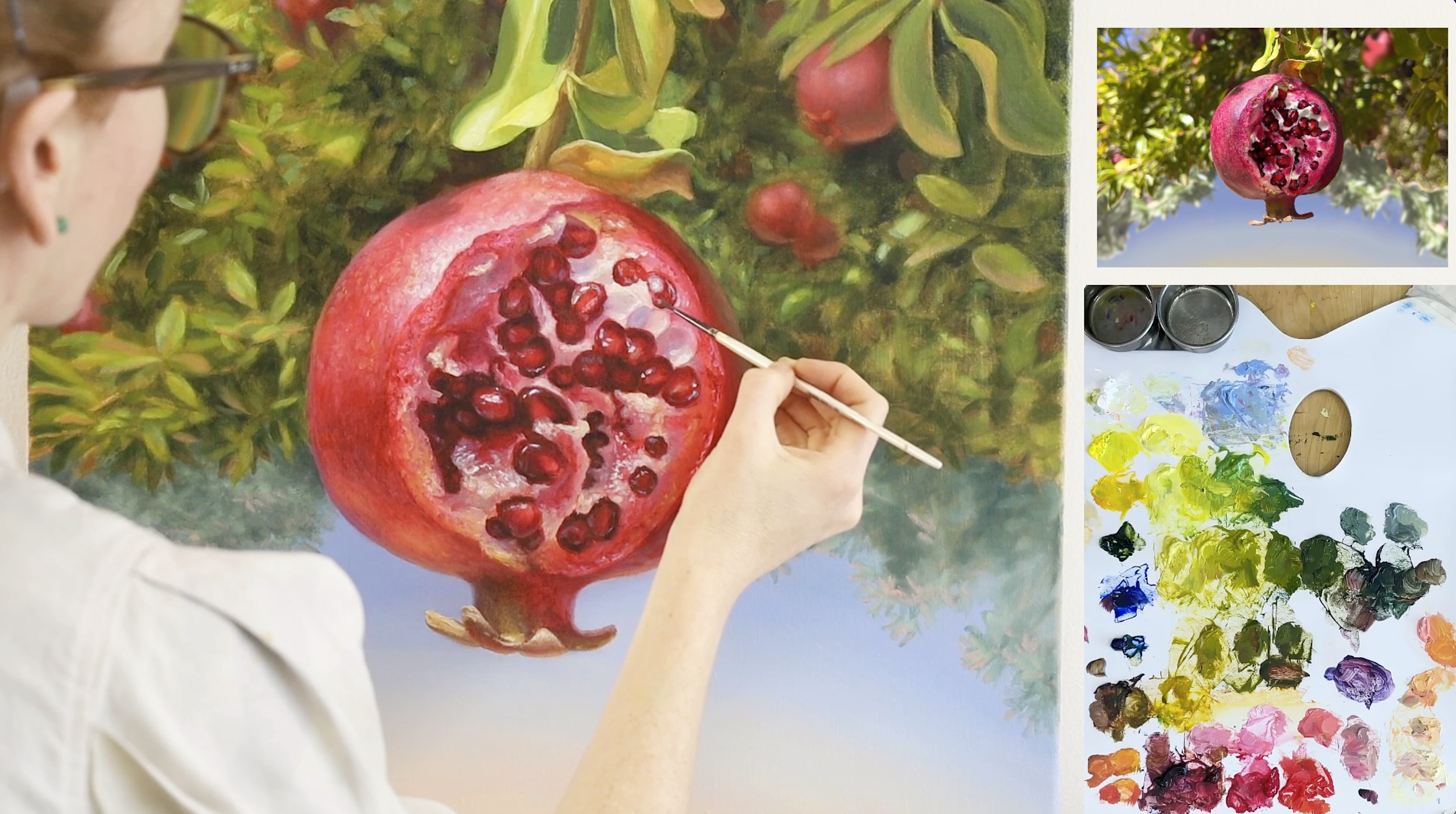
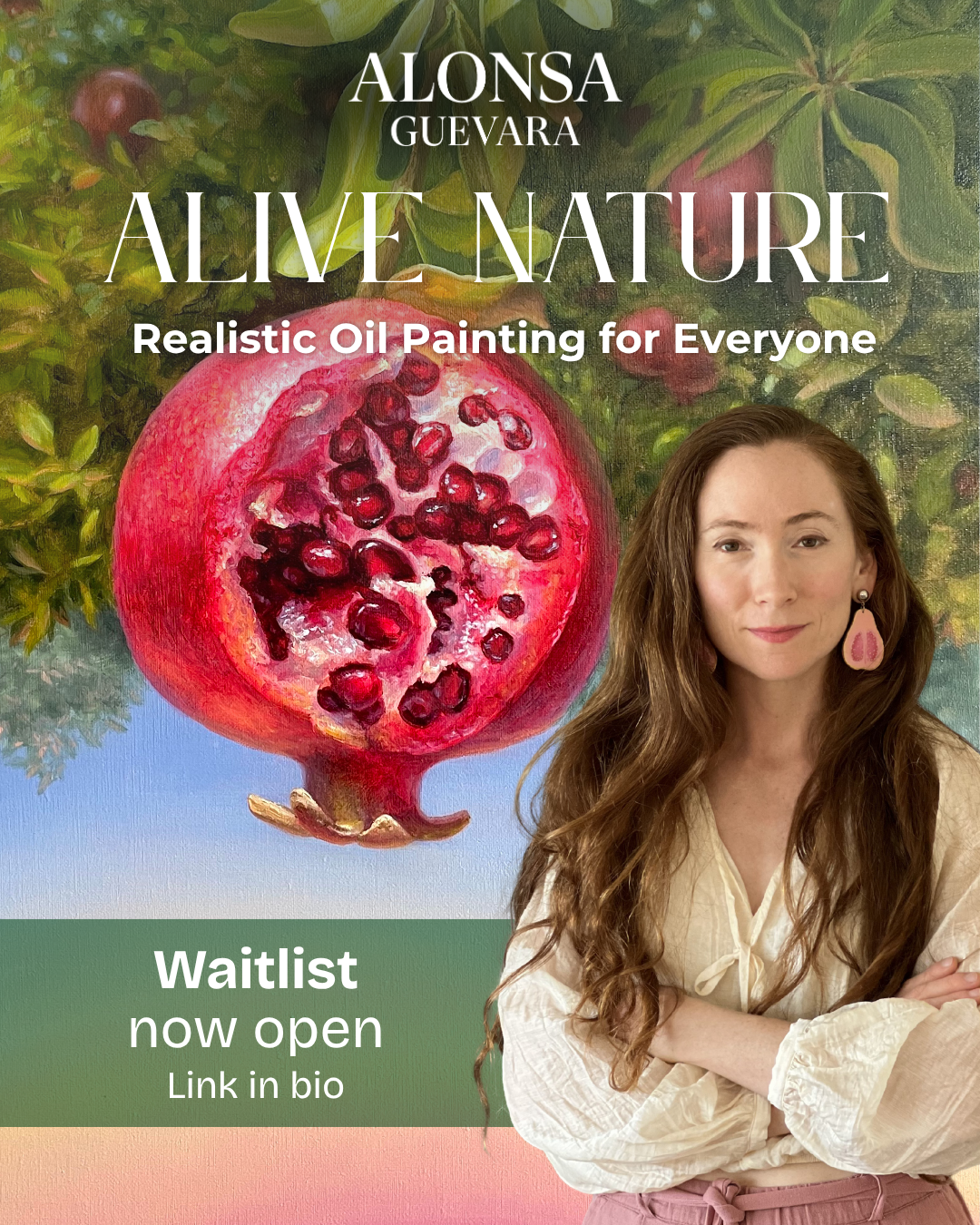
Guevara announced her new online course, Alive Nature, for the first time on this episode. It focuses on florals, botanicals, and fruit, and it spans seven modules with more than thirty-five video lessons.
The structure is built around short lessons rather than long unbroken demonstrations. Most exercise videos run ten to fifteen minutes, so a student can watch a lesson in one sitting and then return to paint alongside it. The course moves from brushes and medium through color charts, value studies, monochromatic work, temperature shifts, and complementary color, then into a final guided painting where she works through her full process from reference to final layer.
"There is nothing you need to know to take this course," she says. A painter who has never opened a tube of oil can start at the beginning, and an experienced artist gets the foundations plus her approach to atmosphere and harmony.
Enrollment opens September 16 and closes September 20. Waitlist members receive first access and a discount.
Join the Alive Nature waitlist
Where to Find Alonsa Guevara
Her four week mentorship program opens in October for ten artists. She will be at Untitled Art Fair in Houston beginning October 2, and teaching an in person workshop on painting fruit and personal voice in Bogotá, Colombia in November.
Follow her on Instagram at @alonsaguevara.
Listen to the Episode
Subscribe to the Create! Podcast on Apple Podcasts, Spotify, or wherever you listen.
For more conversations on galleries, pricing, and building a creative career you love, subscribe to the Create! Magazine Substack.