

The Dog's Gaze: How Our Oldest Companions Became the Secret Subject of Art History
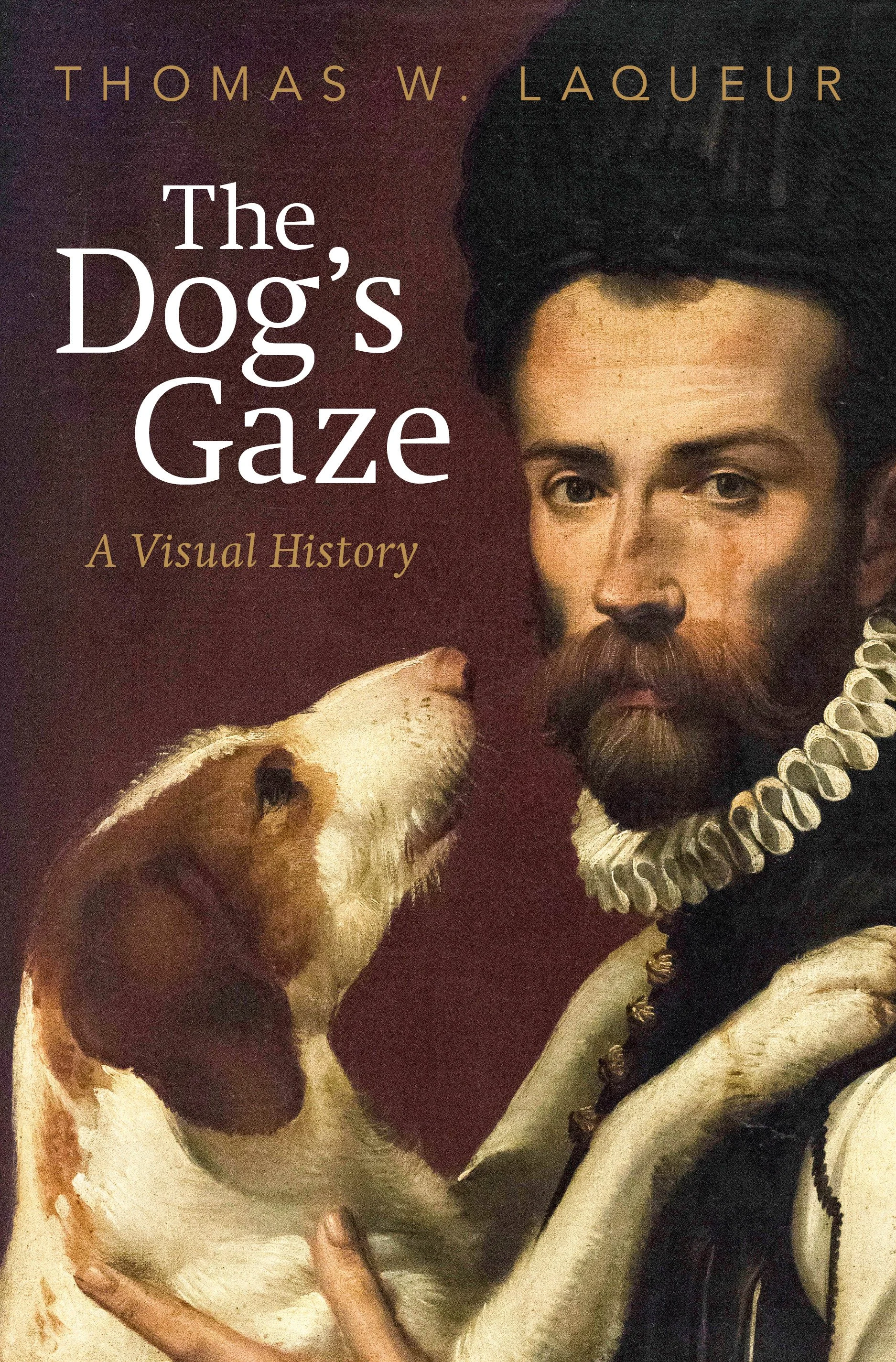
Long before they were called man's best friend, dogs were already showing up in art. In his sweeping new visual history, historian Thomas W. Laqueur traces exactly what they have been doing there all along.
In his new book The Dog's Gaze: A Visual History (Penguin Press), Laqueur makes a quietly astonishing case: that dogs are not decorative details but deliberate witnesses, embedded in Western art from Paleolithic rock paintings to Paula Rego, doing the seeing that artists cannot always do for themselves. They look out at us. They hold the narrative together. They mark what we mourn, what we celebrate, and what we want remembered.
Laqueur, a historian at UC Berkeley, spent decades building this archive, tracing a thread that runs from a 10,000-year-old desert hunting scene to Hogarth, Rembrandt, Velázquez, and Hockney, and finding in every era the same animal performing the same essential work: being our social double, our companion in image as in life.
We spoke with him about what it means for a dog to break the fourth wall of a painting, why the hunt became the first great subject of cross-species art, and what it reveals about us that we have been picturing ourselves alongside dogs for as long as we have been making pictures at all.
What first drew you to the subject of dogs in art, and when did you realize this could become a full visual history rather than a single essay or study?
In 1995, I was asked to give a lecture for an art exhibition called “The New Child in Eighteenth Century British Art,” and was surprised to find that over a third of the masterpieces by Hogarth, Reynolds, Gainsborough, and others had dogs. Their ubiquity piqued my interest. At first, I thought it was a particular characteristic of British art or of the period, but over the decades, I came to see dogs everywhere, from as early as 10,000 years ago to the present. I decided to try to understand why. The archive of art with dogs is so rich that it needs a book to explore fully.
You describe dogs as “social doppelgängers” in art. Can you explain what you mean by that, and why dogs in particular occupy this role more than other animals?
Evolution has created in the dog a sociable animal that is interested in looking at, and with, us and the world I inhabit. No other animal comes close. God had a dog, according to a Native American creation story. It is also at least ten thousand years old, the first domesticated animal, which has given us a long time to build intimate relationships. They are a kind of double for visual artists in particular because their work is about seeing. Dogs do a lot of work for them: they see art from the artist's perspective, or they look at elements the painter wants to draw attention to, or they look out at us, the viewers.
Throughout history, dogs have appeared as hunters, companions, witnesses, and even spiritual figures. Which of these roles surprised you most during your research?
I suppose it is the way in which dogs hunt that provides the route through which they go from nature to culture. For tens of thousands of years, we began hunting together; from this, mythologies were born all over the world, and these became subjects of art and literature. But perhaps more surprising was the sheer range of the roles they performed for humans and how intensely interested we have been, as a species, in representing them in art.
Many dogs in paintings seem to look directly out at the viewer. How does that gaze change the way we read an image or understand the artist’s intention?
They break the fourth wall that seems to enclose a picture and invite us in, while at the same time still firmly within the image. It is a neat trick on the part of artists to manage to do both. I am not sure they speak to an artist’s intentions so much as they are part of the repertoire of representation.
Were there specific artists or artworks that became anchors for this book, ones you found yourself returning to again and again? How do depictions of dogs help us understand changing ideas about morality, loyalty, and intimacy across different historical periods?
The rock paintings in the Arabian desert of hunters and dogs from 10,000 years ago captured my imagination. It is the first visual representation of humans doing anything with an animal. The very long history of art representing the mythology of the hunt—of the story of the goddess of the hunt, Diane, and the hunter Actaeon, who inadvertently saw her naked and whom she, as punishment, turned into a deer and was devoured by his dogs-surprised me. So did the fact that one could just about give a credible course in western art history using only masterpieces with dogs: from Greek vases, to Roman frescos, to the great artists of the Renaissance, north and south, (Giotto, Titian, Veronese, Velazques, Durer, Rembrandt) to the impressionists and on to Picasso, George Groz, Franz Marc etc. to artists of our period—Paula Rego, Wegman, Joan Brown, Hockney.
I don’t think ideas of morality, loyalty, and intimacy have not changed as much as the contexts in which they are represented: less mythological and religious and more ordinary life, less just of the upper classes and more for everyone else.
What do you hope contemporary artists, historians, or readers take away from The Dog’s Gaze about how we see ourselves through animals in art?
I hope they appreciate more the nature of our intimacy with animals and with the dog in particular. We as a species are not alone.